(Pesticide Action Network (PAN) - Europe )
Introduction
The pesticide registration process relies on a combination of binding regulations (hard law) and non-binding administrative and technical instruments (soft law). Regulations determine which pesticide products may enter the market by establishing criteria related to chemical efficacy, economic feasibility, and potential risks to human health and the environment. They also specify the evidentiary standards required for the assessment of pesticide-related risks. Administrative and technical instruments frame the regulatory procedures necessary to ensure compliance with these criteria and related evidential standards.
Within this framework, regulatory science procedures play a central role: they set out the scientific and methodological requirements—such as test protocols and parameters—to assess pesticide risks. They thus define what qualifies as valid data-knowledge about chemicals and their effects in the regulatory framework1. These procedures are set out in formally non-binding guidance documents and represent a cornerstone of the registration process, as they determine if the toxic effects of the substance under assessment are deemed acceptable. It is essential that they should remain aligned with the most recent scientific evidence, to ensure an adequate assessment of potential pesticide risks. However, since the adoption of Regulation (EC) No. 1107/2009 on pesticide authorization in 20092, several guidance documents have remained outdated, unapproved, or have not been developed at all.
Moreover, because these scientific protocols are intended to verify the toxicity of substances for which manufacturers seek market authorization in the European Union (EU), their design—including the selection of protocols and parameters—must be insulated from the influence of pesticide producers, to prevent obvious conflicts of interest.
However, the agrochemical industry has historically been involved at various levels in the production of guidance documents, and has exercised a long-standing cultural hegemony over the founding principles of regulatory science. Several studies have documented its influence on the definition of risk assessment principles, standards and tests, highlighting the fraught relationships between the industry, government authorities and scientific experts3.
The EU bee risk assessment is no exception: the currently enforced scheme (produced by the European and Mediterranean Plant Protection Organisation – EPPO), known as the “EPPO test methods”4, is based on the work of the ICPPR's bee protection group5, a panel of experts whose many conflicts of interest have been repeatedly denounced since 20076. Its meetings are often sponsored by the agrochemical industry, and several of its bee experts involved in designing the EPPO test methods have close links with the main pesticide producers, when they are not directly employed by them7.
Since 2010, Members of the EU Parliament and beekeepers' associations have expressed their concern to the European Commission (EC) about the quality of the current risk assessment scheme, particularly with regard to the EPPO test methods. The latter constitute a good example of a risk assessment scheme that is ignorant by design: they ignore for example certain routes of exposure, as well as chronic and sublethal effects8 and impacts on juveniles, whose deleterious effects on bee health have been highlighted by scientific research from the 2000s onwards9. Furthermore, the EPPO tests methods (devised in 2002 and insufficiently updated in 2010) predate the current pesticide Regulation, promulgated in 2009, which established higher protection standards for non-target organisms, and therefore they are not in line with the current—and more stringent—legal requirements.
In this context, in March 2011, the EC mandated the European Food Security Authority (EFSA) to review the EPPO tests methods in the light of current scientific evidence, in particular in relation to the assessment of chronic risks to bees, exposure to low doses, and accumulative effects of pesticides. Following the EC’s mandate, EFSA published a "Scientific Opinion on the Science Behind the Development of a Risk Assessment of Plant Protection Products on Bees”10. This Scientific Opinion identifies major flaws in the EPPO scheme and indicates the changes needed for an effective risk assessment. On this basis, EFSA published, in 2013, the “Guidance Document on the Risk Assessment of Plant Protection Products on Bees (Apis mellifera, Bombus spp. and solitary bees)” (hereafter Bee GD)11.
However, the agrochemical industry opposed this document and succeeded in deconstructing the scientific consensus around it, which led to the stalling of its adoption. This scientific delegitimisation was instrumental to the industry’s overarching objective: securing a full revision of the Bee GD. Ultimately, this objective was achieved: in 2019, following seven years of stalemate, the EC formally mandated EFSA to revise the entire document.
How did the industry manage to undermine the scientific authority of the European regulatory authority? The following analysis attempts to shed light on its strategy to reach this goal. Beside scientific literature and reports, it is mainly based on: 1) documents obtained through requests for access to documents (A2D) from the EC, and 2) Standing Committee on Plants, Animals, Food and Feed (SCoPAFF) minutes.
The EFSA Bee Guidance Document: a regulatory revolution
The 2013 Bee GD can be considered as a regulatory revolution of the risk assessment on bees. For the first time, it addressed previously overlooked routes of exposure and toxic effects of pesticides on bees (e.g. chronic, accumulative and larval toxicity, sublethal effects, and the toxicity of metabolites). It also broadened the scope of risk assessment beyond the domestic honey bee (Apis mellifera) to encompass bumblebees and solitary bees.
Another major innovation of the Bee GD was the establishment of a Specific Protection Goal (SPG), which defines the maximum tolerable level of colony mortality following the use of a pesticide. It set this threshold at a 7% reduction in colony size. Moreover, in response to the substantial lack of internationally validated test guidelines, EFSA introduced into the risk assessment framework several test methods that were either not yet validated or in the final stages of validation. This approach aimed to ensure that critical effects could be assessed despite the absence of fully standardised methodologies.
This is an important point, as the absence of internationally validated test guidelines—from the Organisation for Economic Co-operation and Development (OECD), or comparable bodies—constitutes a persistent challenge in risk assessment. While the use of such guidelines is standard practice in regulatory contexts—ensuring international methodological harmonisation—many tests essential for a comprehensive evaluation of risks to pollinators (and arthropods more broadly) remain unvalidated, partly because OECD validation typically takes at least 15 years12.
The lack of OECD-validated tests is frequently cited as a justification for omitting assessments of several toxic effects, even when these effects have been consistently demonstrated in academic research and when reliable, though not yet validated, testing methods exist. The resulting discrepancy between current scientific understanding of pesticide impacts and the availability of internationally sanctioned test guidelines is considerable. Consequently, well-documented harmful effects on pollinators are routinely ignored in regulatory risk assessments, on the grounds that validated protocols are lacking. This is precisely the gap that EFSA tried to bridge in the 2013 Bee GD, by including robust, albeit not fully validated, test protocols into the risk-assessment framework.
Beyond its direct impact on EU pesticide risk-assessment procedures for bees, the innovative character of the GD had broader implications for the regulatory “space” and its underlying “culture”13. The epistemic forms that shape this culture—encompassing methods of data collection, testing approaches, experimental design, and evidentiary standards—are not purely scientific. Rather, they are historically contingent, shaped by the prevailing assumptions about risk and safety in a given period14.
In this context, the EFSA Bee GD constituted a significant shift in regulatory culture, challenging many of the foundational assumptions of the traditional epistemic framework of regulatory science and its “ignorant by design” pattern. Notably, it redrew the boundaries between “done” and “undone” science15 by incorporating recent academic findings and by introducing protocols to assess effects for which internationally validated guidelines were not yet available. In doing so, it contested the historically entrenched dominance of a particular epistemic form of pesticide risk assessment—one that contributes to the production of ignorance by excluding certain kinds of knowledge from regulatory consideration16.
It is important to recall that, unlike earlier risk-assessment schemes—that were largely shaped by the pesticide industry—this document was developed by a panel composed primarily of independent researchers. This composition likely contributed to challenging the industry’s long-standing dominance over the regulatory culture surrounding pesticides.
As noted above, the document was published in 2013, but its implementation at the EU level required formal endorsement by the SCoPAFF, whose mandate spans the entire food supply chain, including pesticide authorisation, management, and the approval of relevant scientific guidances.
This requirement reflects the functional division between risk assessment and risk management (i.e. the scientific and the political/legal level). The scientific risk assessment of pesticides is carried out by risk assessors, i.e. regulatory agencies—EFSA at the EU level—while decisions on pesticide approvals and broader risk-management measures fall to risk managers, namely the SCoPAFF. This committee is composed of representatives from all EU Member States and chaired by the EC. Despite its central role in pesticide decision-making, the SCoPAFF remains a relatively obscure component of the EU governance structure. A brief explanation of its functioning is therefore necessary.
The SCoPAFF and the comitology system
The SCoPAFF is part of the so-called “comitology” system, or committee procedure, i.e. “the technical procedures through which the EC implements EU laws once they are adopted by the Parliament and Council. Broadly speaking, before it can implement an EU legal act, the Commission must consult, for the detailed implementing measures it proposes, a committee where experts from every EU country are represented”17. It is worth noticing that guidance documents on pesticides are not technically “legal acts” but are submitted nevertheless to the SCoPAFF endorsement. Therefore, when considering the functional division between risk assessors and risk managers, one may wonder why scientific guidelines for risk assessments need to be approved by the SCoPAFF at all. With other regulatory sectors, EFSA can formulate and adopt risk assessment criteria and guidelines whose applications do not require a political vote in comitology18.
It should be noted that the comitology system is not submitted to the transparency rules which apply to other EU institutions. Names of participants are not public, individual Member States’ votes are confidential, minutes of deliberations are not detailed.
The opacity of the comitology’s operating procedures, the ambiguity surrounding the composition of its committees, and the closed nature of its deliberations have long attracted criticism, particularly from the European Parliament, whose role within the comitology system remains extremely limited. Concerns have also been expressed about the gap between primary legislation and the secondary measures adopted to implement it. Such criticisms highlight that, despite the fact that the comitology is formally presented as a primarily technical process, considerable discretion persists in how legislative provisions are interpreted and operationalised. This, in turn, unsettles the presumed boundary between the technical and the political in both legal theory and regulatory practice, underscoring the need to examine how this boundary can be strategically instrumentalised. By design, the comitology’s technocratic orientation narrows the space for democratic debate and heightens the role of expert knowledge, which is manifest in its reliance on specialist groups and committees19.
The SCoPAFF’s lack of transparency is compounded by a similar lack of transparency affecting several national competent authorities regarding their procedures for managing links of interest20. Indeed, the SCoPAFF is composed of scientific experts representing national competent authorities.
The agrochemical industry’s opposition
Between 2013 and 2019, the Bee GD was discussed 27 times within the SCoPAFF, which never adopted the document, due to the lack of a qualified majority. It is worth noting that, in 2013, the document benefited from broad scientific, institutional and political consensus. Moreover, this committee had already endorsed, in 2012, the SPG for bees, whose validation is the responsibility of risk managers, by agreeing on the threshold of 7% maximum acceptable colony-level mortality following the use of a pesticide, as proposed by EFSA. In other words, at the time of publication of the Bee GD (2013), there was a consensus among Member States on the 7% SPG.
But one stakeholder was overtly opposing the new GD: the pesticide industry, as can be inferred from the comments that the European Crop Protection Association (ECPA), the powerful association of the agrochemical industry in the EU (now CropLife) and individual agrochemical firms submitted during the public consultation21 on the draft GD, in 2012. Following this consultation, EFSA made some modifications and corrections to this draft, albeit without altering the general scientific framework and assumptions, and published the GD’s final version. At this point, the only way that the document and/or its adoption could still be challenged was through the SCoPAFF. It is therefore in the latter’s opaque context that the agrochemical industry exerted its pressure to oppose the EFSA Bee GD.
Based on the documents obtained through A2D, as well as industry publications, we can partly measure the lobbying exerted by the agrochemical industry on the SCoPAFF and the EC throughout the discussion of the Bee GD, in order to deconstruct the scientific, institutional and political consensus around it.
It is noteworthy that the A2D documents suggest (fig. 1) that the industry enjoyed relatively open access to, and familiarity with, the SCoPAFF members, even though the identities of these members are officially confidential and unavailable to stakeholders or the public. The European Commission remains firm on this confidentiality, ostensibly to prevent any undue influence on the committee’s members.
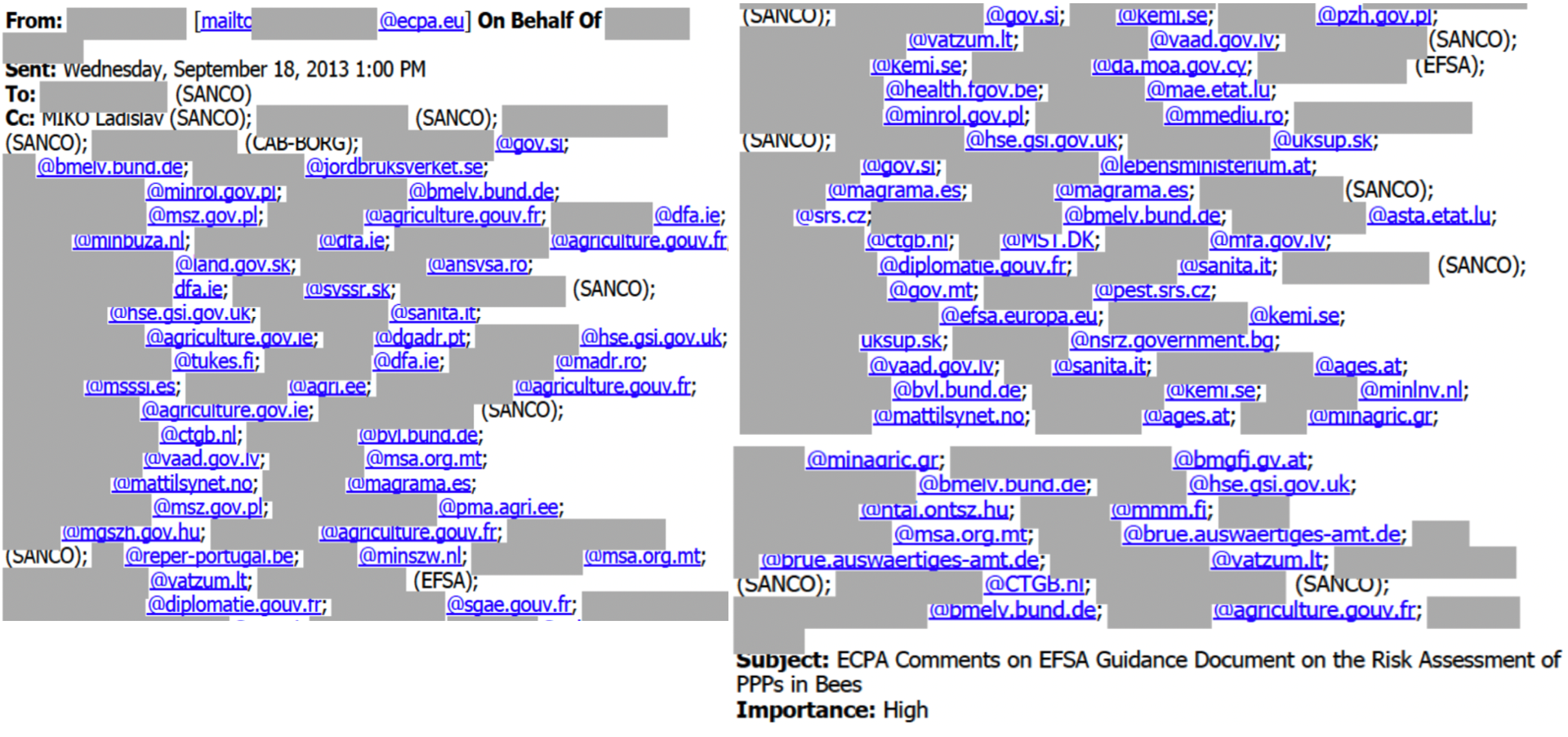
Excerpt of email from ECPA to EC (SANCO), showing email addresses of SCoPAFF’s members - 18 September 2013.
Dismantling consensus on the Bee GD was far from straightforward, as it required: 1) undermining the scientific legitimacy of EFSA’s work; 2) redirecting the EC’s institutional stance; and 3) persuading a qualified majority of Member States to oppose the Bee GD and to repudiate the SPG to which they had previously agreed.
To achieve this, the industry deployed a multifaceted strategy grounded in four interrelated lines of argumentation, scientific, legal, economic, and practical. A comprehensive analysis of this strategy would warrant a separate study; I will here focus exclusively on the principal arguments used to challenge the scientific foundations of the GD.
The industry’s arguments against the scientific basis of the EFSA Bee GD
The agrochemical industry challenged numerous scientific assumptions underlying the Bee GD, spanning issues such as the criteria for field tests (higher tiers)22 and the inclusion of experimental test guidelines not yet validated by the OECD. However, two aspects stood at the core of the industry’s scientific critique: the chronic toxicity test and the SPG.
It is noteworthy that both measures were introduced for the first time in a bee-specific risk assessment. The chronic toxicity test was added in response to growing scientific evidence that newer generations of pesticides—characterised by high persistence and biological activity at very low concentrations—may exert severe effects on bees when exposure occurs at low doses over extended periods. Such effects were ignored in the existing risk-assessment framework, which remained focused on short-term, high-dose exposure. Likewise, the EPPO test methods lacked a specific maximum mortality threshold for pesticide use. These two significant shortcomings of the EPPO scheme were regarded as contributing factors to the ongoing decline of bee populations.
The analysis below therefore concentrates on these two central points.
The chronic toxicity test
The industry contested the science underpinning parameters of the chronic oral toxicity test, claiming that its related trigger value was exceedingly protective (i.e. too conservative). A trigger value is the threshold establishing a dose or concentration that, if breached, indicates a potential excessive toxicity of the tested substance, thus “triggering” further investigation or management response.
In order to prove its point, the agrochemical industry conducted an impact analysis25 assessing how many pesticides already authorized on the EU market would pass, or fail, the screening/first tier26 of the new GD, i.e. the laboratory tests constituting the first battery of tests in the risk assessment procedure, including the chronic toxicity test.
On the basis of the pass/fail rate results of this impact analysis, the industry claimed that “the screening tier risk assessment would lead 90% of all substances for honey bees and 100% for bumble bees and solitary bees to fail the first tier. The EFSA guidance lacks focus and therefore fails to distinguish effectively which substances merit higher tier testing. […] We believe that it will be almost impossible to register any new or existing insecticide in Europe and the regulatory hurdles will be unnecessary high for herbicides and fungicides unless the guidance changes significantly.”
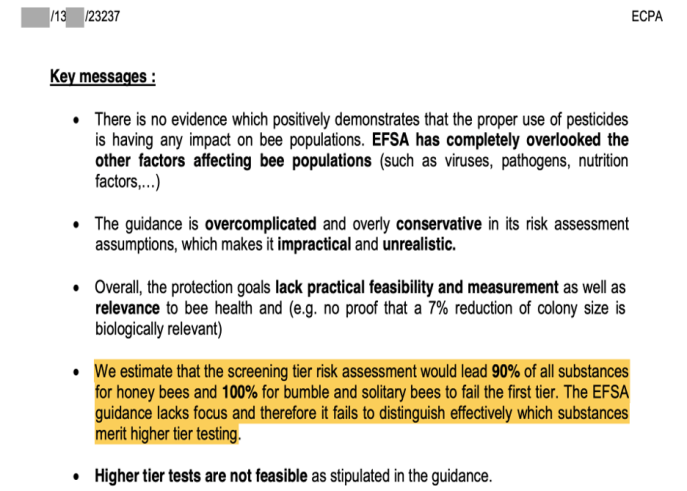
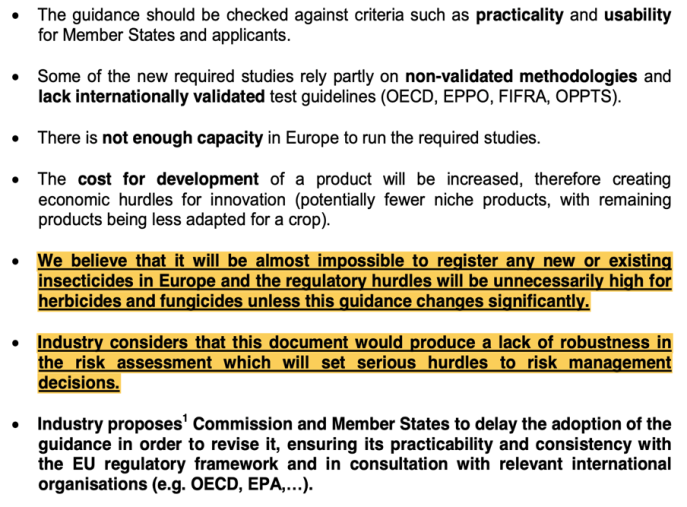
Excerpt - ECPA position on the Bee GD. Email from ECPA to the EC (SANCO) - 18 September 2013.
In other words, what the agrochemical industry asserted through its impact analysis was that the adoption of the Bee GD would entail a virtual halt to the use of pesticides in the EU, i.e. a major disuption to intensive agriculture. The industry cited this impact analysis profusely over the years during which the GD was discussed, using it as a scientific demonstration of the incongruity of the GD, as well as of the danger for EU agriculture and food security that its adoption would have entailed.
However, this impact analysis was never validated by EFSA. On the contrary, documents obtained through A2D (email exchanges between the EC and EFSA), show that EFSA had also conducted an impact study on the pass/fail rate, whose results were very different from those of the industry’s analysis. Indeed, as one EFSA expert wrote to the EC, the Authority’s pass/fail analysis showed that many pesticides would pass the screening /first tier (laboratory) tests: “As you can see below—writes the EFSA expert to the EC—the screening + the first level in the scheme is not overly conservative as always claimed by the industry. Even 50% of insecticides pass the acute assessment and 30% the chronic assessment (maybe we are not conservative enough? 😊)” the EFSA official adds ironically.
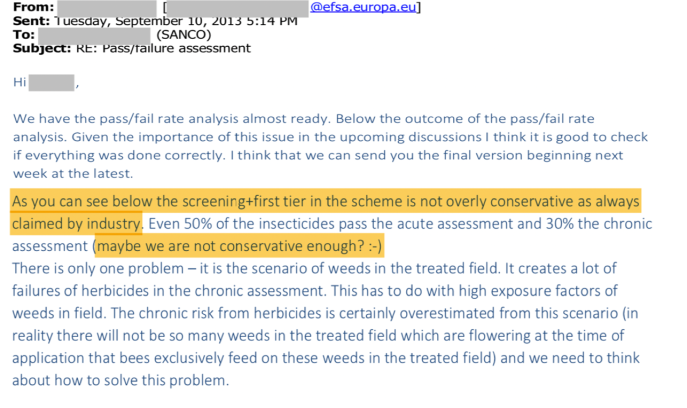
Excerpt of email from EFSA to EC (SANCO) - 10 September 2013.
In other words, according to the EFSA’s pass/failure analysis, the industry’s data were not correct. With the exception of herbicides—where a calculation issue arises due to the presence of weeds in treated fields—EFSA’s analysis indicated a generally favorable pass rate. More importantly, these results were consistent with current scientific evidence from academic studies, as well as with a key assumption motivating the updating of risk assessment on bees: namely, that certain pesticides on the market exhibited substantial chronic toxicity to bees.
Nevertheless, its own impact analysis remained the industry’s scientific warhorse, throughout the overall period of the discussions, in order to convince Member States not to adopt the GD.
It is important to emphasise that trigger values are calibrated on the SPG, and that the latter is highly dependent on the baseline natural mortality rate used in its determination. Conceptually, the SPG for bees is derived by adding an acceptable level of additional colony loss—attributable to pesticide exposure—to the natural mortality rate, ensuring that this added reduction does not compromise colony survival or functioning. Once the SPG is defined (for example, a maximum 7% colony reduction), the trigger values are set accordingly, to ensure that the risk assessment can identify substances exceeding this threshold. The conservativeness of trigger values directly reflects the chosen SPG: the more protective the SPG, the more stringent the trigger values, and the greater the number of substances that will be classified as posing unacceptable risk to bees.
Consequently, the industry’s other main scientific challenge to the GD was directed against the methods and data employed to establish the SPG.
The SPG: the notion of “acceptable loss” of biodiversity
SPGs constitute a central component of environmental risk assessment, because, as already mentioned, they are supposed to establish the acceptable impact of pesticides on biodiversity, namely, the maximum loss of non-target organisms that the use of these substances can entail without impairing ecosystem functions and the provision of ecosystem services.
Regulation (EC) No. 1107/2009 on pesticide authorization establishes only a broad protection goal: according to art 4.3(e), a plant protection product (PPP) may be authorised only if it has “no unacceptable effects on the environment.”
But what is an unacceptable effect on the environment? SPGs are intended to operationalise this requirement by quantifying what constitutes an “acceptable” effect: for honey bees, this means identifying a threshold of colony mortality that does not compromise colony survival or functioning.
It is important to consider that, while from an ecological science perspective any (direct or indirect) impact on biodiversity disrupting ecological stability and function should be considered as unacceptable, the regulatory determination of what counts as an “acceptable” impact reflects not only scientific evidence but also socio-economic considerations, which may differ according to perspectives and interests.
For beekeepers for instance, any additional loss has an impact on colony health and honey production: if the colony’s internal mechanisms can compensate, up to a certain functional level, a given percentage of colony reduction, this compensation nevertheless comes at a certain cost in terms of honey production and colony robustness and vulnerability. On the other hand, from the industry’s (and conventional farming’s) perspective, the more stringent the SPG is, the fewer products will be authorized on the market.
It is clear that the notion of what constitutes an “acceptable” impact varies among stakeholders and is far from self-evident or merely the result of a choice based on science: rather, it is ultimately a cultural/political choice, shaped by prevailing views on societal priorities and visions of economic and ecological “sustainability”.
When EFSA drafted the Bee GD, the EU was witnessing widespread pollinator declines and severe honey bee colony losses, while accumulating scientific evidence implicating pesticides, especially neonicotinoids, in these declines. In this context of heightened scientific and public concern, both risk assessors and risk managers opted for a precautionary approach. The 7% SPG was selected to ensure a negligible-effect threshold of pesticides27. In other words, the intention was to minimize the effect of pesticides on bees, in order to help reverse the ongoing pollinator decline.
The industry fiercely opposed this approach, alleging that “[o]verall, the protection goals lack practical feasibility and measurement as well as relevance to bee health (e.g. no proof that a 7% reduction of colony size is biologically relevant)” (see email reproduced at § 35) .
In particular, the industry’s criticisms centered on two main elements of the EFSA’s scientific approach to define the SPG: 1) the level of natural background mortality chosen as a baseline, and 2) the model28 adopted to simulate colony dynamics.
As per the first point, it should be specified that to define forager natural mortality, EFSA selected the lowest mortality rate found in the scientific literature (5.3%), opting for a worst-case approach. This precautionary approach was strongly criticized by the industry, which argued that the study in question29 was not conducted in an agricultural environment, where bee mortality is higher30. Indeed, the study was conducted in a non-treated urban botanical garden.
As for the second point—the model employed by EFSA to simulate colony dynamics—the industry claimed that this modelling tool was too “simplistic”, arguing that a better model to estimate the “normal”/realistic development and mortality of a colony was now available, the BEEHAVE model31 (co-funded by Syngenta). This model, ECPA claimed, explicitly estimated that “an effect level of 20-30% for honeybees (3 times higher than the current EFSA proposal of 7%) would be a negligible impact on colony strength and over-wintering success”32.
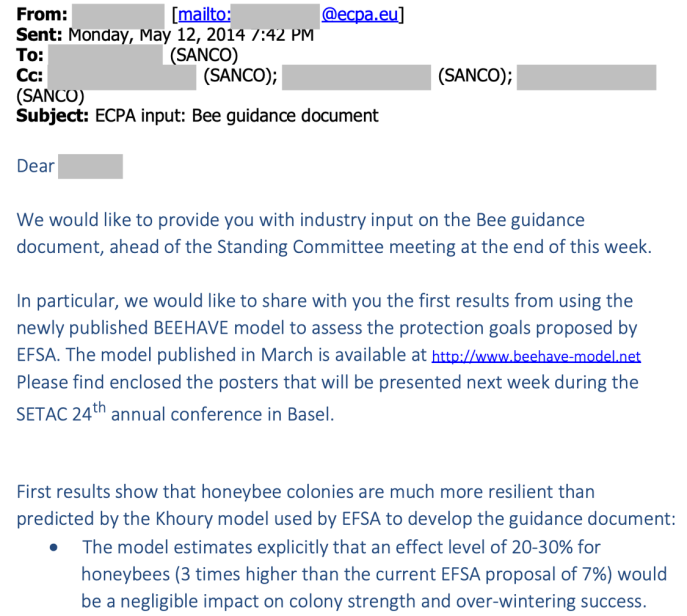
Excerpt of email from ECPA to EC (SANCO) - 12 May 2014
Toward a new normal – what is “natural” bee mortality?
In the years that followed, the agrochemical industry stakeholders repeatedly requested to redefine the SPG and revise the (chronic toxicity) trigger value for honey bees. Their primary objective was to establish a new SPG informed by the BEEHAVE model, capable of providing risk managers with multiple options for the acceptable mortality level of the bee colony. They also sought an upward revision of the natural background mortality rate and the abandonment of the “worst-case” approach, as such changes would automatically result in less conservative trigger values.
All these demands were incorporated into the framework of the revision of the 2013 EFSA Bee GD, whose mandate (EC 2019) included a request that EFSA “provide a review and summary of evidence as regards bee background mortality, in particular considering realistic bee keeping management for Apis mellifera and natural background mortality” 33.
It is worth noticing that the draft protocol produced by EFSA for this review, listing the criteria to conduct the summary of evidence on natural background mortality, indicated that only data from studies conducted in agricultural landscapes, i.e. where application of pesticides is more likely to occur, would be considered relevant34. It also specified that studies conducted with bees exposed to anthropogenic effects, e.g. to chemicals that are normally used in agricultural landscapes, would be eligible for the review.
Civil society organisations engaged in the revision of the Bee GD raised concerns regarding these criteria. They noted that, while the protocol defined “natural background mortality” as bee mortality resulting from factors “independent of accidental exposure to pesticides,” it simultaneously treated as “normal” (i.e., natural) the exposure of bees to chemicals routinely applied in agricultural landscapes. This approach disregarded the growing body of evidence showing that bees are consistently exposed to complex mixtures of agrochemicals in such environments, and that this cocktail of compounds exerts detrimental chronic and sublethal effects on bee health, longevity, and mortality, as largely shown by academic research35.
In this context, they argued, any assessment of natural background mortality must account for the potential influence of such ubiquitous exposures on measured mortality rates, and failure to consider this exposure may lead to an overestimation of natural background mortality.
These criteria for the review of background mortality marked a significant departure from the previous approach: whereas the 2013 Bee GD aimed to define natural background mortality as that occurring in uncontaminated environments, the new approach intended to “naturalise” current pollinator decline by treating the elevated mortality levels observed in pesticide-contaminated agricultural landscapes as the new baseline for “natural” bee background mortality36.
Not surprisingly, the new “background mortality” was higher than that adopted as a benchmark in 201337. These new data were then used to run simulations of colony dynamics with the model demanded by the industry, BEEHAVE, in order “to derive a threshold of acceptable effect on colony size based on background variability” (i.e. the SPG). The results, i.e. the percentage difference between the mean colony size and the lower limit of the operating range (EFSA 2020b), ranged between 20.3% - 31.1% and -1.4%* - 0.2%.
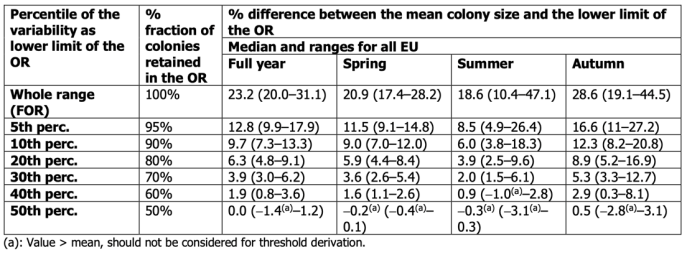
Results obtained through the BEEHAVE model on background variability (EFSA 2020b: 19).
In other words, the model showed a wide range of “background mortality”, thus offering multiple options to risk managers. But the main question, i.e., what level of mortality among these options could be considered acceptable, remained unanswered. The ball was then back in the risk managers’ court (i.e. the SCoPAFF). They had to choose one of these different percentages in order to set the appropriate SPG for honey bees.
The issue was discussed at the SCoPAFF meeting of 24-25 March 2021, where four Member States considered that accepting a colony size reduction of up to 23% would offer sufficient protection (i.e. represent a “negligible” effect). Eleven Member States suggested a protection goal within a range of 10% to 12.8% of colony size reduction. Four Member States indicated a preference for maintaining the same level of acceptable colony size reduction as stipulated in the 2013 EFSA Guidance Document (7%). Four Member States did not express any opinion.
In order to avoid stalling the discussions, or risking that the SCoPAFF members should agree on a non-protective SPG, both civil society associations and the European Parliament (which were advocating to maintain the 7% SPG of the 2013 GD) asked the EC for the issue to be discussed at a forthcoming meeting of the Council for Agriculture and Fisheries (AGRIFISH). In this way, it was felt that the discussion would have been more transparent, given the transparency rules which apply to the Council. On April 2021, the EC wrote38 to the Presidency of the Council of Ministers and to the Chair of the Committee on the Environment, Public Health and Food Safety of the European Parliament proposing a public debate in order to solve the continuing disagreements on the SPG. The discussion took place at the AGRIFISH Council of 28-29 June 2021.
During this public session, a clear majority of Member States supported the Commission's proposal for a SPG limiting the maximum permitted level of honeybee colony size reduction at 10% after the use of a pesticide, contrary to what had previously happened behind the closed doors of the SCoPAFF. It is likely that the transfer of the discussion from the opaque environment of the SCoPAFF to the more transparent arena of the Council played an important role in reaching this agreement on the 10% SPG.
The revised EFSA Bee GD was published in 202339. From an ecotoxicological point of view, although it is less ambitious than the previous one, it constitutes an obvious improvement on the obsolete EPPO scheme. From an epistemological point of view however, it is regrettable that the groundbreaking approach which characterized the epistemic form of the 2013 version should have disappeared. The 2013 GD was clearly committed to the general objective of protection, by adopting a precautionary and pragmatic approach to address potential risks as much as possible. For instance, when facing the lack of OECD guidelines to test crucial aspects of toxicity, the approach was, whenever possible, to propose feasible experimental protocols to produce relevant data. Similarly, in presence of inconclusive or insufficient data to decide on the relevance of a potential source of risk, the 2013 version opted for the adoption of a precautionary approach, by including that potential risk in the assessment. This approach is no longer present in the new GD. A robust scheme to address combined and sublethal effects is still lacking. SPGs for wild bees have not been defined. In the absence of OECD-validated test guidelines to assess given effects, the approach of the revised version consists in ignoring these effects. In certain cases, even existing OECD-validated guidelines are not mandatorily requested (this is the case, for instance, for the acute toxicity tests for bumble bees, OECD 246 and 247). Most of the agrochemical industry’s requests have been integrated into the revision, starting with the revision itself, which constituted the key demand of the industry. At the time of writing (2026), the 2023 GD is supposedly in the final steps of adoption. Meanwhile, 13 years have passed without an effective assessment of the risk of pesticides on bees.
Conclusion
This brief analysis of the trajectory of the EFSA Bee GD has shown that the 2013 version marked a groundbreaking shift in the EU’s epistemic form of pesticide risk assessment on bees, which immediately met with strong industry resistance. In order to dismantle the consensus around this GD, industry actors deployed a multifaceted strategy, undermining in particular certain scientific assumptions embedded in the document. Much of this lobbying unfolded within the opaque structures of the SCoPAFF, which had a key role in the 7-year blockage of the document.
The industry’s efforts concentrated especially on discrediting two highly technical yet crucial parameters, which ultimately determine the overall level of pollinator protection against pesticides. Both these elements had for the first time been introduced in the EU pesticide risk assessment on bees: the chronic toxicity test and its related trigger value—i.e. the threshold indicating a potential chronic toxicity of the compound under assessment—and the SPG—i.e. maximum threshold of colony reduction, following the use of a pesticide, deemed to be “negligible” in order to maintain colony strength and viability.
To contest EFSA’s chronic toxicity metrics, the agro-chemical industry firms conducted an impact analysis purporting that nearly all pesticides authorised in the EU would fail the new test. Although EFSA explicitly rejected these conclusions, the analysis became the center piece of an alarmist and deeply misleading campaign warning Member States of catastrophic consequences for EU agriculture and food security should the guidance—and its chronic toxicity test—be adopted.
Industry opposition to the SPG established by the 2013 Bee GD followed a different logic: an attempt to redefine the boundaries of what counts as “natural” mortality and “negligible” pesticide effects. Whereas EFSA adopted a protective approach by considering natural bee mortality as that occurring in non-contaminated areas and set the negligible-effect threshold at a 7% colony reduction, industry actors sought to normalise the elevated mortality levels observed in pesticide-intensive agricultural landscapes. Using the BEEHAVE mechanistic model, they proposed that colony losses of 20–30% should be interpreted as “natural” and that pesticide-induced declines within this range should be regarded as negligible.
This strategy effectively attempted to recast the severe pollinator declines associated with conventional agriculture not as a crisis to be reversed but as a new baseline of normality. The integration of this approach into the revision of the Bee GD illustrates the extent to which the industry succeeded in shaping what counts as legitimate regulatory knowledge about bees and pesticides.
Yet the recalibration of “natural” mortality and the use of the BEEHAVE model ultimately failed to resolve the fundamental political question: how much biodiversity are we prepared to sacrifice in order to sustain an agricultural system dependent on the extensive use of synthetic pesticides? Although the expanded set of thresholds could have enabled risk managers in the SCoPAFF committee to choose less protective values, or even to prolong the stalemate, the shift of deliberations from the SCoPAFF to the more transparent Council setting proved decisive. It enabled the adoption of a final agreement capping permissible mortality at 10%. This outcome underscores the crucial importance of transparency throughout the regulatory process—especially within the SCoPAFF, which wields considerable influence yet remains shielded from public accountability.
The inadequacy of current pesticide risk-assessment procedures in safeguarding non-target organisms is widely acknowledged. Numerous research initiatives are now working to bridge these gaps, and their proposed approaches have the potential to substantially reshape our understanding of the true risks posed by pesticides. Yet, meaningful progress in the ecological risk assessment of pesticides will also require a transformation of the regulatory culture itself, which is unlikely to happen without a stronger awareness and involvement of the public. Without such change, we risk repeating the dead ends of previous efforts, as exemplified by the Bee GD case. The effectiveness of these new methodologies in protecting biodiversity—and their likelihood of timely adoption—ultimately hinges on establishing an independent, transparent regulatory culture, that unequivocally rejects being “ignorant by design”.
Notes
1
Daniel Lee Kleinman, Sainath Suryanarayanan, “Dying Bees and the Social Production of Ignorance”, Science, Technology & Human Values, vol. 38, no 4, 2013, p. 492-517. DOI: 10.1177/0162243912442576
2
Regulation (EC) No 1107/2009 of the European Parliament and of the Council of 21 October 2009 concerning the placing of plant protection products on the market and repealing Council Directives 79/117/EEC and 91/414/EEC.
3
See, among others: Soraya Boudia, Nathalie Jas (dir.), Powerless Science? Science and Politics in a Toxic World, New York/Oxford, Berghahn Books, 2014; Soraya Boudia, Nathalie Jas, Gouverner un monde toxique, Versailles, Éditions Quae, 2019; Jean-Noël Jouzel, Pesticides. Comment ignorer ce que l’on sait, Paris, Presses de Sciences Po, 2019.
4
These methods are: the EPPO guidance “Standard PP 3/10(2)” (see: European and Mediterranean Plant Protection Organization, “Environmental risk assessment scheme for plant protection products”, OEPP/EPPO Bulletin, vol. 33, 2003, p. 141-145.https://doi.org/10.1046/j.1365-2338.2003.00633.x) and the EPPO guidance “Standard PP 1/170 (4)” (see: European and Mediterranean Plant Protection Organization, “Side-effects on Honey Bees”, OEPP/EPPO Bulletin, vol. 40, 2010, p. 313-319. https://doi.org/10.1046/j.1365-2338.2003.00619.x).
5
International Commission on Plant-Pollinator Relationships, formerly International Commission on Plant-Bee Relationships.
6
For an analysis of conflicts of interest inside the ICPPR, see: Hans Muilerman, “Industry writing its own rules”, Rapport PAN Europe & Générations Futures, 2018; Stéphane Foucart, Et le monde devint silencieux. Comment l’agrochimie a détruit les insectes, Paris, Seuil, 2019.
7
Hans Muilerman, “Industry writing its own rules”, Rapport PAN Europe & Générations Futures, 2018.
8
Effects occurring following exposure to low or infinitesimal doses that, while not provoking immediate death, impair important functions (reproduction, orientation, feeding behavior etc.), entailing delayed lethal effects or deleterious impacts on colony/population dynamics.
9
See, among others: Christine Doucet-Personeni, Marie-Pierre Halm, François Touffet, Agnès Rortais, Gilles Arnold, « Imidaclopride utilisé en enrobage de semences (Gaucho) et troubles des abeilles », Rapport du Comité Scientifique et Technique de l’Etude Multifactorielle des Troubles des Abeilles, 2003; Jean-Marc Bonmatin, Isabelle Moineau, Rémy Charvet, Marie-Étienne Colin, Claude Fleche, Edgar R. Bengsch, “Behaviour of Imidacloprid in Fields. Toxicity for Honey Bees”, in Lichtfouse, E., Schwarzbauer, J., Robert, D. (eds), Environmental Chemistry, Springer, Berlin, Heidelberg, pp. 483-494. https://doi.org/10.1007/3-540-26531-7_44; Mickaël Henry, Mickaël Béguin, Fabrice Requier, Olivier Rollin, Jean-François Odoux, Pierre Aupinel, Jean Aptel, Simon Tchamitchian, Axel Decourtye, “A Common Pesticide Decreases Foraging Success and Survival in Honey Bees”, Science, vol. 336, 2012, p. 348-350. DOI: 10.1126/science.1215039; Penelope R. Whitehorn, Stephanie O’Connor, Felix L. Wäckers, Dave Goulson, “Neonicotinoid Pesticide Reduces Bumble Bee Colony Growth and Queen Production”, Science, vol. 336, 2012, p. 351-352. https://doi.org/10.1126/science.1215025; Laura Maxim, Jeroen van der Sluijs, “Seed-dressing systemic insecticides and honeybees”, in Late Lessons from Early Warnings: Science, Precaution, Innovation, European Environmental Agency, 2013, p. 401-426. https://doi.org/10.2800/70069; Laura W. Pisa et al., “Effects of neonicotinoids and fipronil on non-target invertebrates”, Environmental Science and Pollution Research, vol. 22, n°1, 2014, p. 68-102. https://doi.org/10.1007/s11356-014-3471-x.
10
European Food Safety Authority (EFSA), “Scientific Opinion on the science behind the development of a risk assessment of plant protection products on bees”, EFSA Journal, vol. 10, n°5, 2012, article 2668. https://doi.org/10.2903/j.efsa.2012.2668
11
European Food Safety Authority (EFSA), “Guidance Document on the risk assessment of plant protection products on bees”, EFSA Journal, vol. 11, n°7, 2013, article 3295. https://doi.org/10.2903/j.efsa.2013.3295. A final version, published on 04 July 2014, replaced the earlier version published on 4 July 2013.
12
On the problematic normative role played by the OECD in producing/validating test guidelines for pesticide toxicity on the international stage, see: Annie Martin, « La production des savoirs sur les pesticides dans la réglementation européenne », VertigO, 2016. https://doi.org/10.4000/vertigo.17878
13
On the concepts of “regulatory space” and “culture”, see Leigh Hancher, Michael Moran, « Organizing Regulatory Space », Leigh Hancher, Michael Moran (dir.), Capitalism, Culture and Economic Regulation, Oxford, Clarendon Press, 1989, p. 271-300.
14
Daniel Lee Kleinman, Sainath Suryanarayanan, “Dying Bees and the Social Production of Ignorance”, Science, Technology & Human Values, vol. 38, 2013, p. 492-517. https://doi.org/10.1177/0162243912442576
15
On the notion of “undone” science, see: Scott Frickel, Sarah Gibbon, et al., “Undone Science: Charting Social Movement and Civil Society Challenges to Research Agenda Setting”, Science, Technology & Human Values, vol. 35, no 4, 2010, p. 444-473.
16
Daniel Lee Kleinman, Sainath Suryanarayanan, “Dying Bees and the Social Production of Ignorance”, Science, Technology & Human Values, vol. 38, no 4, 2013, p. 492-517.
17
Cécile Robert, “The political uses of expertise in the EU decision making: the case of comitology”, Research Report Greens/EFA Group in the European Parliament, 2019. https://hal.science/halshs-03021131v1
18
Anca Dinu, Elina Karamfilova, “Regulation (EC) 1107/2009 on the Placing of Plant Protection Products on the Market”, European Parliamentary Research Service, 2018. http://www.europarl.europa.eu/thinktank
19
Cécile Robert, “The political uses of expertise in the EU decision making: the case of comitology”, Research Report Greens/EFA Group in the European Parliament, 2019. https://hal.science/halshs-03021131v1
20
Guillaume Karr, Giovanni Prete, Stéphane Duboc, Denis Zmirou-Navier, “Management of links of interest in European Union expertise authorities dealing with plant protection products”, Environmental Sciences Europe, vol. 35, art. no96, 2023. https://doi.org/10.1186/s12302-023-00757-1
21
European Food Safety Authority (EFSA), “Outcome of the Public Consultation on the draft Guidance Document on the Risk Assessment of Plant Protection Products on Bees”, EFSA Supporting Publications, 2013, EN-451. https://doi.org/10.2903/sp.efsa.2013.EN-451
22
Environmental risk assessment is generally organised following a progressive, three-step testing procedure. The first step consists in assessing the toxicity of a pesticide through laboratory tests (first tier): if this phase shows a potential risk for non-target organisms, further investigation, in more realistic conditions, should be conducted in higher tiers: semi-field studies and, if necessary, field studies.
23
Exposure-Toxicity Ratio (ETR): <0.03.
24
The criticism targeted in particular the methods used to derive the trigger value of 0.03 which, according to the industry, did not take into account several factors, including the shape and nature of the dose-response used to generate the endpoint, see: Mark Miles, Zhiguo Gao, Thomas G. Preuss, “Linking protection goals to trigger values using compound specific properties: Chronic risks to bees”, in Proceedings of the 13th International Symposium of the ICP-PR Bee Protection Group (Hazards of pesticides to bees), València, 18-20 octobre 2017, Julius-Kühn-Archiv, n°462, 2018, p. 77-81. https://doi.org/10.5073/jka.2018.462.018
25
The industry impact analysis was finalized in 2013 and circulated from that year on. It was presented in 2017 at the 13th International Symposium of the ICPPR Bee Protection Group, sponsored by Bayer, and published in the Symposium proceedings in 2018: Mark Miles, Anne Alix, Ralf Becker, Mark Coulson, Axel Dinter, Laurent Oger, Eric Pilling, Alison Sharples, Graham Weyman, “Improving pesticide regulation by use of impact analyses: A case study for bees”, Julius-Kühn-Archiv, n°462, 2018, p. 86-90. https://doi.org/10.5073/jka.2018.462.021.
26
See note 22.
27
Based on expert judgement, the following nomenclature was defined in the GD (2013: 98) for the magnitudes of detrimental impacts on colony, or “effect sizes”: large (effect): > 35% reduction (in colony size); medium: 15% to 35% reduction; small: 7% to 15% reduction; negligible: 3.5% to 7% reduction.
28
Daniel S. Khoury, Michael R. Myerscough, Andrew B. Barron, “A Quantitative Model of Honey Bee Colony Population Dynamics”, PLoS ONE, vol. 6, n° 4, 2011. https://doi.org/10.1371/journal.pone.0018491
29
Paul Schmid-Hempel, Thomas Wolf, “Foraging Effort and Life Span of Workers in a Social Insect”, Journal of Animal Ecology, vol. 57, no 2, 1988, p. 500-521. https://doi.org/10.2307/4921
30
See ECPA’s comments in the first public consultation on the 2013 draft GD here: https://www.efsa.europa.eu/sites/default/files/topic/files/BeeGD_1st_consultation_comments.xlsx
31
Martin A. Becher, Volker Grimm, Pernille Thorbek, Johannes Horn, Paul J. Kennedy, Juliet L. Osborne, “BEEHAVE: a systems model of honeybee colony dynamics and foraging to explore multifactorial causes of colony failure”, Journal of Applied Ecology, vol. 51, n°2, 2014, p. 470-482. https://doi.org/10.1111/1365-2664.12222
32
Email from ECPA to EC, May, 12, 2014.
34
European Food Safety Authority (EFSA), “Draft protocol for the scientific assessment of background mortality of bees”, 2019.
35
See, for a meta-analysis of more than 4,000 bibliographic references on the impacts of pesticides on biodiversity and environmental contamination by pesticides, Laure Mamy, Sandrine Pesce, Wilfried Sanchez, Marc Amichot et al., « Impacts des produits phytopharmaceutiques sur la biodiversité et les services écosystémiques », Rapport INRAE/IFREMER, 2022. https://hal.inrae.fr/hal-03777257v1
36
See the final version of EFSA’s review on bee background mortality: European Food Safety Authority (EFSA), Antonio Ippolito, Maria del Aguila, Elisa Aiassa, Isabel Muñoz Guajardo, Francesca M. Neri, Fernando Alvarez, Oliver Mosbach-Schulz, Csilla Szentes, “Review of the evidence on bee background mortality”, EFSA Supporting Publications, vol. 17, n°7, 2020, EN-1880. https://doi.org/10.2903/sp.efsa.2020.EN-188
37
Although it no longer limited eligible studies to agro-chemical environments - despite these still constituting the majority - the principal demand of civil society organisations was not addressed. Specifically, their request to establish a baseline for “natural” mortality drawn from genuinely natural areas, rather than from landscapes where bees are routinely exposed to agricultural chemicals was disregarded. See PAN Europe’s List of follow-up questions, en ligne : https://www.pan-europe.info/sites/pan-europe.info/files/public/resources/links/PANEurope%20questions%20follow%20up%20Sep%202020-1.pdf#overlay-context=.
39
European Food Safety Authority (EFSA), “Revised guidance on the risk assessment of plant protection products on bees”, EFSA Journal, vol. 21, n°5, article 7989, 2023, article 7989. https://doi.org/10.2903/j.efsa.2023.7989