

(OVD-Info)
Introduction
Jehovah’s Witnesses, who emerged in the Russian Empire at the end of the 19th century, are among those religious groups that—much like during the Soviet period—have been among the most persecuted in post-Soviet Russia. The movement was banned in 2017 as an “extremist organization”; its Russian branch was shut down and its local associations dissolved.
The evolution of the situation of Jehovah’s Witnesses in the Russian Federation reflects both the trajectory of the principle of secularism, proclaimed in the 1993 Constitution, and the stance adopted by political authorities toward what they label as “sects.” Following the approach adopted in Étienne Ollion’s work on anti-sect policies in France
1, this article examines these developments in detail. It explores how the “sect issue” was brought onto the political agenda, the rhetoric used to oppose Jehovah’s Witnesses, the categories of thought mobilized and the meanings attached to them. It also identifies the social actors—particularly religious ones—who have contributed to framing the movement’s presence in post-Soviet Russia as a “matter of public order,” thereby paving the way for increasingly large-scale arrests.
The study begins by analyzing the transformations in religious policy in the 1990s and their impact on the development of the Jehovah’s Witness movement. This policy was partly inherited from Soviet anti-religious practices and was shaped both by pressure from the Russian Orthodox Church and by Western influence. It highlights the increasing alignment of social and political actors, who—though drawing on slightly different rhetorical frameworks—came to share a common opposition to the movement. Finally, drawing on data from OVD-Info, it demonstrates the scale of the persecution of Jehovah’s Witnesses over the past decade and shows how it has intensified since the beginning of Russia’s war of aggression against Ukraine.
In the 1990s: A Contrasted Policy Under Western Influence
The history of Jehovah’s Witnesses in the USSR was marked by persecution.
2During the interwar period, communities of Witnesses had developed in the Baltic countries and in the eastern regions of Romania, Poland, and Czechoslovakia. Following the annexation of these territories, the Soviet state organized mass arrests of believers—then numbering around ten thousand—and deported them to Siberia in two secret operations, in 1949 and 1951.
Academic discourse drew a distinction between “sects” and “churches.
3” Soviet writings on sects focused primarily on condemning so-called “extremist” groups, which included unregistered groups, particularly Jehovah’s Witnesses, the most extensively studied movement.
4The Witnesses were notably criticized for refusing to obey the state, which they viewed as doomed to destruction at Armageddon—the ultimate confrontation between good and evil. They were also reproached for refusing to bear arms, to vote, and more generally for not conforming to the cultural and political norms of Soviet life—their children, for example, did not participate in the Young Pioneers or the Komsomol
5.
In a context of religious liberalization—driven in part by Mikhail Gorbachev’s desire to ease relations with the West—the USSR adopted a new law on freedom of conscience in October 1990. In line with international conventions, this law defined freedom of conscience and religion as an inalienable right, affirmed the equality of belief and non-belief, and clearly established the separation of church and state. It also granted religious movements broad freedom to conduct their activities, while simplifying the registration process that allowed religious associations to obtain legal status.
At the time, the Russian Orthodox Church remained weakened by the compromises made by a great part of its hierarchy with the Soviet regime and lacked the capacity to meet the growing spiritual demand. In this context, Jehovah’s Witnesses—along with many Protestant movements—experienced significant growth throughout the first half of the 1990s.
6However, as early as 1993, the Russian Orthodox Church began lobbying for amendments to the 1990 law, which it viewed as overly favorable to religious pluralism. In December 1994, its Synod of Bishops adopted a resolution asserting that sectarian views were undermining “the traditional organization of life formed under the influence of the Russian Orthodox Church (…), the spiritual and moral ideal (…) shared by all,” and threatening the integrity of the Russian people’s “national consciousness and cultural identity.
7”
The shift toward restricting the rights of religious minorities first emerged at the regional level. Between 1993 and 1997, one-third of Russia’s 89 regions adopted new legislation on freedom of conscience, including Kaliningrad, Tver, Tula, Kalmykia, Ryazan, Vologda, Kostroma, Tatarstan, Udmurtia, Perm, Sverdlovsk, Khanty-Mansi, Tuva, Amur, Khabarovsk, Sakhalin, Yaroslavl, Ulyanovsk, Bashkortostan, Yamalo-Nenets, Buryatia, Sakha (Yakutia), and Primorye.
8In some regions, such laws could exist without being made public.
These regions were less exposed than the federal center to international human rights pressure and more frequently became arenas for political and economic compromise between secular and religious authorities. In many instances, local Orthodox hierarchies played a decisive role, providing expertise—or even granting approval—for the registration of religious organizations. Meanwhile, the officials responsible for reviewing applications were often the same individuals who had worked for the Soviet-era Council for Religious Affairs.
The situation also evolved at the federal level. From the mid-1990s onward, both the tone and the measures directed at so-called “sectarian” groups increasingly echoed those of the Soviet period. A document issued by the Ministry of the Interior on October 23, 1996 illustrates this shift: in a section devoted to combating “organized crime,” several “foreign sects” were identified as undesirable on the grounds that they could contribute to social disorder. Jehovah’s Witnesses were among the movements mentioned. These groups were accused of being “asocial,” of rejecting constitutional obligations, of endangering citizens’ moral, psychological, and physical well-being, and of recruiting children and breaking up families. The document also claimed that religious groups use humanitarian aid to infiltrate Soviet institutions. Such allegations echoed the familiar accusations of espionage from the Soviet era.
This shift was further consolidated by Federal Law No. 125-FZ of September 26, 1997, “On Freedom of Conscience and Religious Associations.” Drafted under pressure from the Russian Orthodox Church and in a context of growing geopolitical and identity-based retrenchment, the law affirmed in its preamble the “special role of Orthodoxy in the history of Russia.” Article 8.5 sought to curb the influence of new religions in Russia by stating:
“The right to use in its name the terms ‘Russia,’ ‘Russian,’ and their derivatives shall be granted to a centralized religious organization whose structures have operated, on a legal basis, for at least fifty years at the time it submits an application for official registration to the registering authority.”
The law retained certain elements inherited from Soviet legislation. These included the specific treatment of “foreign religious organizations” and the requirement that religious groups unable to provide documentation proving their existence for at least fifteen years in a given territory must undergo annual re-registration until that period has elapsed (Art. 27.3). Yet no organization was required to issue certificates of fifteen years’ presence.
These legislative developments can be explained by several converging factors: growing concern, from the mid-1990s onward, with Russian national identity; the increasing influence of the Russian Orthodox Church, which called for the defense of its “canonical territory”; and two enduring political logics. The first is the perceived need for state control over religious movements; the second, inherited from the Soviet period, is the “besieged fortress” mentality, marked by suspicion toward foreign influence. Missionaries, in this context, were often portrayed as agents of imperialism and as threats to national unity. In a country where proselytism has long been viewed as both illegal and morally questionable, the religious practices of certain new groups—including their doctrines, methods of attracting converts, and approaches to fundraising—were frequently seen as unfamiliar, atypical, or even “unnatural.” Legislation also evolved in a context in which Russia sought to align itself with the international community; proponents of more restrictive laws justified their position by invoking practices commonly found in religious legislation worldwide.
9The distinction between “traditional” and “non-traditional” religions—initially confined to regional laws in the 1990s—gradually became the cornerstone of a discriminatory federal policy toward religious movements in Russia. This policy was progressively reinforced by an increasingly stringent repressive framework, as the authorities placed the defense of national security at the heart of their political agenda.
A coalition of discourses in the fight against Jehovah’s Witnesses
The authorities’ stance toward Jehovah’s Witnesses is often interpreted as being shaped, on the one hand, by national exclusivism and, on the other, by the Soviet legacy of state atheism. Russian Federation strategic documents on national security have consistently linked national security with spiritual security. However, this perspective should not obscure the fact that discourses on “totalitarian sects” have been circulated by a variety of actors and have also developed under the influence of Western anti-cult associations.
Anti-sect mobilizations
From the early 1990s, particularly with the emergence of the new religious movement known as the Great White Brotherhood, parent groups seeking ways to “save” their children from the influence of new religious movements (NMR) were formed in Moscow and Saint Petersburg. They relied on Western sources and information in their efforts to combat these movements.
In 1991, Alexander Dvorkin, a former Soviet émigré who had acquired American citizenship, returned to Russia and established within the Russian Orthodox Church the St. Irenaeus of Lyons Information Center (ILIC), an anti-sect organization modeled on Western anti-cult associations. The Dialogue Centre, founded in Denmark by a Lutheran theologian, played a significant role in shaping the ILIC; Dvorkin later became its vice-president. Western secular organizations have also contributed to anti-sect rhetoric, including ADFI (Association pour la Défense des Familles et de l’Individu victimes de sectes) in France, FAIR (Family, Action, Information and Resource) in the United Kingdom, CAN (Cult Awareness Network), and AFF (American Family Foundation) in the United States. The influence of these groups has played an important role in shaping Russia’s approach to “sects.” Before 1994, Russian anti-sect discourse did not rely on notions such as “brainwashing” or “mind control,” and some social actors instead attributed “magical powers” to NMR leaders. The introduction of these Western concepts, presented as more scientific, helped transform Russian rhetoric. The “sect” phenomenon became increasingly medicalized: recruitment was described as mental manipulation, participation as a psychiatric disorder, and members as victims in need of care. Disseminated through widely circulated American popular works in Russia, these ideas led some Russian psychiatrists to call for measures against NRMs, including Jehovah’s Witnesses.
10Movements opposing so-called “totalitarian” or “destructive” sects have taken diverse forms. In the 2000s and 2010s, mobilizations targeting Jehovah’s Witnesses occurred across Russia—in Saint Petersburg, Novgorod, Belgorod, Krasnodar Krai, Stavropol Krai, Rostov-on-Don, Chelyabinsk, Mordovia, and Novosibirsk. These initiatives were organized by a range of religious, political and social actors: pro-government political youth groups such as “Idushchie vmeste,” Nashi, and the Young Guard, as well as the Communist Youth Union; missionary departments of Orthodox dioceses and Orthodox parents’ associations; and nationalist-patriotic groups such as the All-Russian National Union and Cossack organizations. Their actions included calls to ban the movement’s activities, to prohibit the construction of “Kingdom Halls,” and to demand the return of buildings used by Jehovah’s Witnesses. While the available information does not allow for a complete inventory of the grievances raised, several examples illustrate the range of concerns expressed. In 2003, the Communist Youth Union denounced the “spiritual occupation” of Russia. In August 2004, residents of a neighborhood in Novgorod pointed to the alleged risk of suicides among members of the group. In the same year, Cossacks and Orthodox priests argued that the movement’s activities were “political” in nature, since its members were prohibited from performing military service, joining other organizations, voting in elections, honoring the national flag and anthem, or celebrating birthdays and Christian holidays.
11
Defending “spiritual security”
The defense of Russia’s “spiritual security” has been on the political agenda since the 1990s. The 1997 National Security Concept of the Russian Federation already emphasized the importance of spirituality and moral values for the country’s security, stating:
“The activity of the Russian Orthodox Church and the churches of other denominations plays a crucial role in preserving traditional spiritual values. At the same time, it is necessary to consider the destructive role of various religious sects, which cause significant harm to the spiritual life of Russian society, pose a direct threat to the life and health of Russian citizens, and are often used to cover unlawful activities.”
12(p. 25)
Continuing this line, the National Security Strategy adopted in 2000 during Vladimir Putin’s first presidential term highlighted “the negative impact of foreign religious organizations and missionaries.”
“Assurance of the Russian Federation’s national security also includes protecting the cultural and spiritual-moral legacy and the historical traditions and standards of public life, and preserving the cultural heritage of all Russia’s peoples. There must be a state policy to maintain the population’s spiritual and moral welfare, prohibit the use of airtime to promote violence or base instincts, and counter the adverse impact of foreign religious organizations and missionaries."
13
The notion of religious extremism appeared in the National Security Strategy of the Russian Federation to 2020 (2009). It identified as a threat to the country “the extremist activity of nationalist, religious, ethnic organizations and structures, etc.” The 2021 Strategy includes an extensive section on spiritual and moral values and further develops the idea that foreign values not rooted in Russia’s historical traditions pose a danger to the country; it also refers to extremist and terrorist organizations:
“86. The imposition of alien ideals and values, as well as reforms in the fields of education, science, culture, religion, language, and information activities carried out without regard to historical traditions and the experience of previous generations, lead to increased fragmentation and polarization of national societies, undermine the foundations of cultural sovereignty, and weaken political stability and statehood. The revision of basic moral norms and psychological manipulation cause irreparable harm to individuals’ moral well-being, encourage destructive behavior, and create conditions for societal self-destruction. The generational gap is deepening. At the same time, manifestations of aggressive nationalism, xenophobia, religious extremism, and terrorism are increasing.
87. Traditional Russian spiritual, moral, and cultural-historical values are subject to active attacks by the United States and its allies, as well as by transnational corporations and foreign non-profit non-governmental, religious, extremist, and terrorist organizations. They exert informational and psychological influence on individual, group, and societal consciousness by spreading social and moral attitudes that contradict the traditions, beliefs, and convictions of the peoples of the Russian Federation.”
14
The Destructology Laboratory at Moscow State Linguistic University
In 2018, Roman Silantiev—an Islamic studies scholar who has held various positions within the Moscow Patriarchate
15, served as a member of the CIS Interreligious Council between 2001 and 2006, and has been vice-chair of the Expert Council on Religious Expertise at the Russian Ministry of Justice since 2009—introduced a new discipline called destructology. This field is intended to “offer serious resistance to threats against Russia’s national security” and focuses in particular on “extremist groups, terrorist organizations, and religious sects,” with its analyses intended to inform judicial proceedings.
In 2019, he established the Destructology Laboratory at Moscow State Linguistic University. The laboratory works closely with the Human Rights Defense Center of the World Council of the Russian People, an organization chaired by Patriarch Kirill and aimed at fostering dialogue between religious elites and representatives of various sectors of society.
In a 2020 interview with a journalist from Pravda.ru, one of Silantiev’s collaborators outlined the laboratory’s position on Jehovah’s Witnesses. The group is criticized for refusing to submit to the authorities of the country in which its members reside and for obeying only the organization’s central governing body—arguments that closely echo those used against them during the Soviet era. She also noted that “the most well-known issue is their refusal of blood transfusions. But from the state’s perspective, this is the lesser problem, since there are means to save a person.”
16
Illustration provided by an anonymous OVD-Info volunteer.
The strengthening of the repressive legal framework
Since the 2000s, the legal framework used to repress new religious movements expanded significantly.
Anti-extremism laws
An anti-extremism law was adopted as early as 2002 (No. 114-FZ, “On Counteracting Extremist Activity,” July 25, 2002). Lacking a precise definition of extremism, it grants the authorities broad discretion to target any religious group deemed undesirable. Article 3(2) even allows restrictions on freedom of religion when deemed necessary to “protect state security.” This was followed in 2006 by an anti-terrorism law, which also adopts a broad definition of terrorism (No. 35-FZ, “On Counteracting Terrorism,” March 6, 2006).
In 2008, the authorities established the “Center for Combating Extremism” (“Center E,” from èkstremizm, meaning “extremism” in Russian), a structure within the Main Directorate of the Ministry of Internal Affairs. According to human rights defenders in Russia, this body has played a key role in the persecution of several groups, including Jehovah’s Witnesses.
Additional anti-extremism measures were introduced throughout the 2010s and into the 2020s. On May 25, 2020, a Strategy for Countering Extremism in the Russian Federation until 2025 was adopted, followed by a new Strategy for Countering Extremism in the Russian Federation on December 28, 2024. Also noteworthy is the law of December 30, 2021 (No. 441-FZ), which amended Article 15.3 of the Federal Law “On Information, Information Technologies and Information Protection,” as well as Articles 3 and 5 of the Federal Law “On Amendments to Certain Legislative Acts of the Russian Federation.” This legislation introduced “new grounds for extrajudicial blocking, including content deemed to justify or substantiate extremism, false reports of terrorist acts, materials produced by organizations designated as terrorist or extremist, and links to such content.”
17Further legislative developments followed in 2025. A law adopted on July 23 (No. 215-FZ) introduced amendments to Articles 4 and 16 of the Law on the Media, as well as to Articles 1 and 9 of the 2002 Law on Extremism. Its purpose was to clarify the concept of an extremist community and to refine the legal framework governing the media dissemination of information related to dissolved or banned extremist organizations. In October 2025, Article 4 of the Law on Extremism was amended once more, with the aim of centralizing and strengthening federal oversight in the fight against extremism.
As of 2026, the Criminal Code of the Russian Federation contains a number of provisions addressing “extremism.” The most widely applied are Article 282.2 (organization of, or participation in, the activities of an extremist organization) and Article 282.3 (financing of extremist activity). Under Article 282.2, organizing the activities of a banned extremist organization is punishable by significant terms of imprisonment (generally up to 10 years, and higher—up to 12 years—in aggravated cases), while participation alone may lead to sentences of up to 6 years. Article 282.3 establishes liability for providing or collecting funds or financial services for extremist purposes, with penalties that can reach up to 10 years’ imprisonment. Other related provisions include Article 280 (public calls for extremist activity), Article 282 (incitement of hatred or enmity), Article 282.1 (organization of an extremist community), and several ancillary offenses.
As of the end of March 2026, the list of organizations designated as extremist by the Ministry of Justice of the Russian Federation comprises 133 entries. Some of these entries encompass affiliated structural subdivisions. For example, the entry for the Religious Organization “Administrative Center of Jehovah’s Witnesses in Russia” is supplemented by a list of 395 local religious organizations of Jehovah’s Witnesses.
18
Anti-missionary laws
The issue of proselytism emerged as early as the beginning of the 2000s. A law on foreign citizens dated July 25, 2002 (“On the Legal Status of Foreign Citizens in the Russian Federation,” N°115-FZ) transferred responsibility for issuing visas from the Ministry of Foreign Affairs to the Ministry of Internal Affairs thereby restricting the entry of foreign preachers into Russia. In 2004, several regions adopted their own “anti-missionary” laws, including Belgorod, Voronezh, Kostroma, Kursk, Smolensk, Arkhangelsk, and North Ossetia. However, observers noted significant difficulties in enforcing these measures, and many were later repealed for failing to comply with federal standards and with Article 71 of the 1993 Constitution, which assigns the regulation and protection of human and civil rights and freedoms to the jurisdiction of the Russian Federation.
In July 2016 a new section—Chapter III.1—devoted to missionary activity in Russia was introduced into the 1997 federal law “On Freedom of Conscience and Religious Associations.” This amendment is intended to combat terrorism and enhance public security. During discussions before the Federation Council, it was emphasized that the drafters sought “to put up a barrier against religious organizations that come to Russia and attempt to convert our citizens to their faith.”
19
Undesirable organizations
These laws are complemented by additional provisions targeting so-called “undesirable organizations.”
The designation of an “undesirable organization” constitutes an even more arbitrary tool than accusations of extremism. Its defining feature is the extrajudicial nature of the decision-making process: such designations are issued directly by the Prosecutor General’s Office. Adopted in May 2015, the law on “undesirable organizations” was initially presented as a safeguard against “interference in internal affairs,” but it quickly evolved into a mechanism for criminalizing the activities of international organizations in Russia. The first entities added to the register were major international foundations supporting human rights and the rule of law. Over time, they were joined by foreign media outlets and exiled media, research institutions, anti-war initiatives, and other projects. By the end of March 2026, the register had grown to 340 entries.
In practice, this mechanism operates as a barrier, effectively criminalizing any interaction between Russian citizens and the designated foreign entities. One of its most significant consequences is the criminalization of contacts themselves: any involvement in the activities of such organizations—including participation in online conferences or even accessing their official resources—can lead to prosecution under Article 284.1 of the Criminal Code of the Russian Federation. By the end of March 2026, OVD-Info had recorded 156 criminal cases initiated under this provision.
The persecution of Jehovah’s Witnesses
In February 2019, Roman Silantiev stated in an interview with Interfax:
“Based on court decisions concerning Jehovah’s Witnesses, I have information suggesting that this sect deliberately encourages its members to commit offenses of this kind in order to create a group of individuals who are actually convicted for them, to give them an aura of martyrdom, and to exert pressure on Russia. That is why, in my view, I would call on the judicial authorities to use all available means to ensure that Jehovah’s Witnesses do not receive actual prison sentences.”
20
Such a statement came in a context marked by the growing persecution of Jehovah’s Witnesses.
From the First Attacks to Accusations of Extremism
The first attacks against Jehovah’s Witnesses date back to the late 1990s. The Moscow branch of Jehovah’s Witnesses, which had obtained legal status in December 1993, was denied registration for five consecutive years. Following complaints by an association close to the Russian Orthodox Church, it was dissolved by a district court in 2004. The Jehovah’s Witnesses challenged this ruling before the European Court of Human Rights in Strasbourg, which in 2010 found it unlawful and awarded €70,000 in damages against the Russian state. The Moscow community was ultimately re-registered on June 1, 2015.
The period from 2009 to 2016 was characterized by the systematic dismantling of the legal framework governing the Jehovah’s Witnesses. The process began with the Rostov Regional Court’s 2009 decision to liquidate the Taganrog community—one of the first instances in modern Russia of a religious organization being dissolved under anti-extremism legislation on the basis of its publications. In December 2009, the Supreme Court of the Russian Federation ruled 34 of the organization’s publications “extremist,” giving law enforcement nationwide the authority to treat possession of these materials as grounds for searches and administrative sanctions.
From 2012 onward, a strategy of “local liquidations” became widespread: prohibited brochures were reportedly planted in places of worship, after which the local religious organization would receive a warning and, in the event of a repeated “violation,” face a liquidation lawsuit.
21By 2016, communities in Samara, Abinsk, Belgorod, and Stary Oskol had been closed in this manner.
Although mass arrests began after 2017, the authorities had already begun testing criminal prosecution of individual believers during the preceding years. The most notable case was the “Sixteen’s case” in Taganrog (2011–2016), the first instance in which a group of believers was prosecuted under Article 282.2 of the Criminal Code for “organization and participation in the activities of an extremist organisation” previously dissolved by a court. The proceedings lasted several years and ended in 2015 with convictions for all defendants, including suspended sentences and fines.
22At the same time, believers faced restrictions on their right to alternative civilian service (ACS). Military recruitment offices and courts increasingly refused to grant this option, arguing that Jehovah’s Witnesses’ beliefs “undermine state security,” thereby forcing young men to choose between conscription and criminal liability for draft evasion. This phase culminated in a warning issued by the Prosecutor General’s Office on March 2, 2016, addressed to the Central Administrative Center, which paved the way for the Supreme Court’s nationwide ban on the denomination in April 2017.
23
Criminal Prosecutions of Jehovah’s Witnesses after the Supreme Court Decision (2017–2025)
The Supreme Court’s decision of April 20, 2017, which recognized the “Administrative Center of Jehovah’s Witnesses in Russia” as an extremist organization, marked the beginning of an unprecedented wave of criminal prosecutions. In its aftermath, 395 local organizations and their 2,300 congregations (comprising approximately 175,000 adherents) were dissolved.
24This campaign spread across nearly all regions of the country and even extended to occupied territories of Ukraine, effectively serving as a testing ground for large-scale criminal repression.
Jehovah’s Witnesses stand out for their systematic approach to legal defense: unlike many other persecuted groups, they maintain detailed monitoring of every criminal case. This enables us to consider the data as both representative and as comprehensive as possible regarding state repression.
Debates surrounding the classification of Jehovah’s Witnesses’ activities as extremism
The classification of Jehovah’s Witnesses’ activities as extremism has nevertheless sparked debate. During a meeting of the Presidential Council for Civil Society and Human Rights on December 11, 2018, political scientist Ekaterina Shulman questioned Vladimir Putin about the list of organizations reportedly linked to extremism and terrorism: “There are 489 of them, 404 of which are Jehovah’s Witnesses. I will pause here for emphasis. One can have many criticisms of Jehovah’s Witnesses—they refuse blood transfusions, they do not send their children to hospitals—but they certainly do not call for violence and do not practice it.” In response, the President of the Russian Federation stated: “Jehovah’s Witnesses are Christians as well; I, too, do not quite understand why they would be persecuted. The situation simply needs to be analyzed. I will discuss this with Vyacheslav Mikhailovich [Lebedev], and we will try to do so.”
On February 12, 2019, the Chairman of the Supreme Court, Vyacheslav Lebedev, clarified that Jehovah’s Witnesses are not being arrested for their faith, but for violating the law.25 The Ministry of Justice, for its part, criticized their refusal of blood transfusions, arguing that the organization’s activities posed “a threat to the protection of the rights and interests of society as well as to public security.” However, refusal of blood transfusions does not constitute an act of extremism under the legislation on countering extremism.
On October 28, 2021, the Plenum of the Supreme Court of the Russian Federation ruled that Jehovah’s Witnesses’ worship services, as well as their joint performance of rites and ceremonies, do not in themselves constitute a crime under Article 282.2 of the Criminal Code, despite the liquidation of their legal entities.
How evidence is structured in extremism cases
Criminal cases against Jehovah’s Witnesses are operationally managed by the FSB or the Center E. According to defense lawyers working on these cases, the prosecution’s primary objective in court is to prove the “continuation of activities” of the banned organization. This is achieved through several standardized methods, even as the believers themselves do not deny their affiliation with Jehovah’s Witnesses or renounce their faith, maintaining that their worship is a matter of personal conviction.
To establish this link, the investigative process relies heavily on invasive surveillance, including wiretapping phone calls and installing hidden recording devices in believers’ homes to capture private Bible studies or prayers. In the eyes of the prosecution, any friendly social visit or theological discussion is recontextualized as a “conspiratorial meeting” of an extremist cell. This evidence is frequently bolstered by the testimony of “secret witnesses” or provocateurs—undercover agents who initiate contact with believers under the guise of religious interest, only to later testify that the defendants attempted to "recruit" them or organize illegal gatherings.
Physical evidence also plays a central role, with security forces seizing religious literature and digital files during mass raids. Defense teams have frequently reported that banned materials are planted by operatives to ensure a conviction. Furthermore, the authorities have successfully criminalized the community’s internal support systems; voluntary donations intended for basic needs, such as renting meeting spaces or providing mutual aid to fellow members, are sometimes classified under the law as “financing extremist activity.”
26
Dynamics and scale of persecution
Since 2018, Jehovah’s Witnesses have been subjected to a large number of cases under the article on organizing or participating in the activities of an extremist organization (Article 282.2 of the Criminal Code). Almost 90% of the charges fall under the two parts of this article (organization and participation). Nearly 10% relate to the financing of extremist activities (Article 282.3 of the Criminal Code). As of early 2026, the total number of individuals involved reached 970, of whom 175 are still imprisoned.
27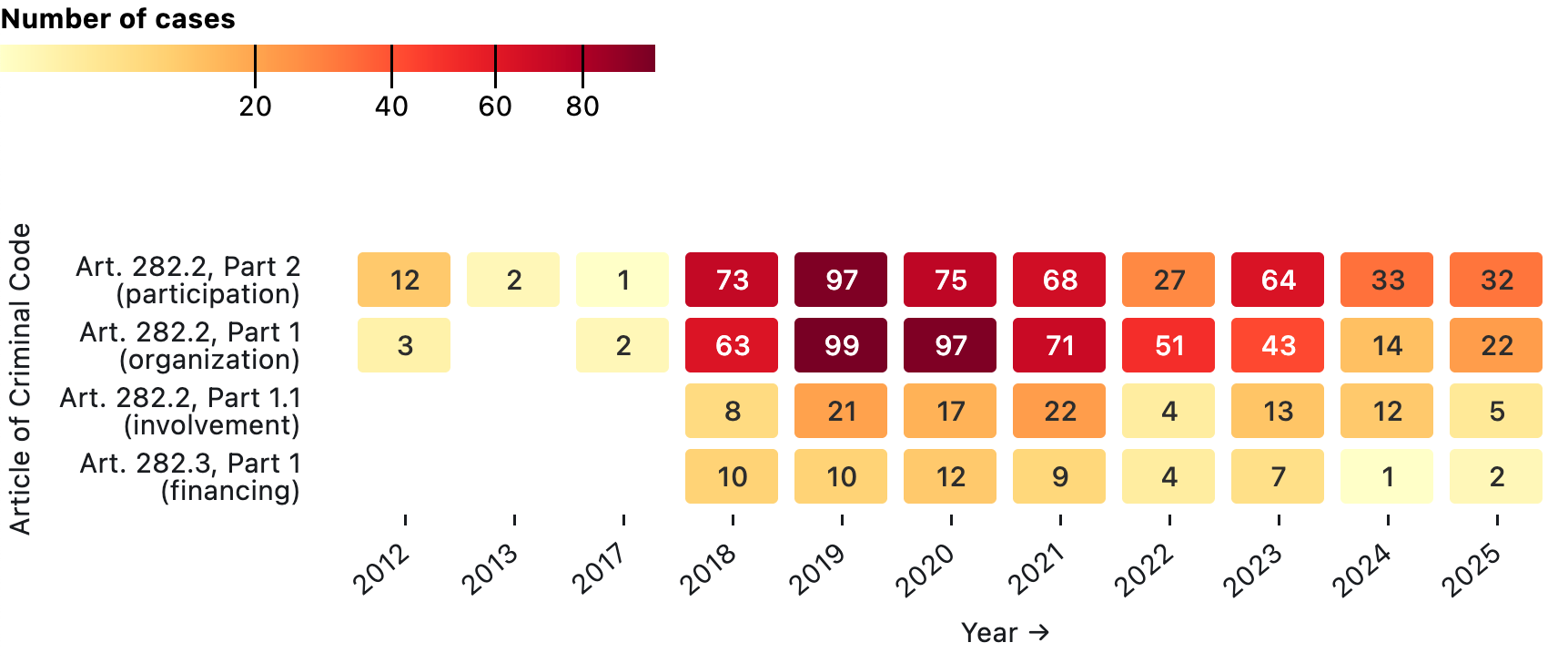
Use of articles on organizing, participating in, involvement in, and financing extremism against Jehovah’s Witnesses in 2012–2025 (note that one individual may simultaneously be charged with multiple criminal offenses).
The peak of law enforcement activity occurred in 2018–2019, when 196 and 169 individuals, respectively, became defendants in new criminal cases. During this period, Jehovah’s Witnesses accounted for nearly half (up to 47%) of all individuals prosecuted for political reasons in Russia. By 2024–2025, the intensity of new case initiation had decreased by approximately three to 3.5 times (to about 50–60 new defendants per year). However, this decline does not indicate an end to repression: Jehovah’s Witnesses still account for around 70% of all individuals who, according to the assessment of OVD-Info, are prosecuted on politically motivated grounds in Russia under the “extremism” provision of Article 282.2 of the Criminal Code.
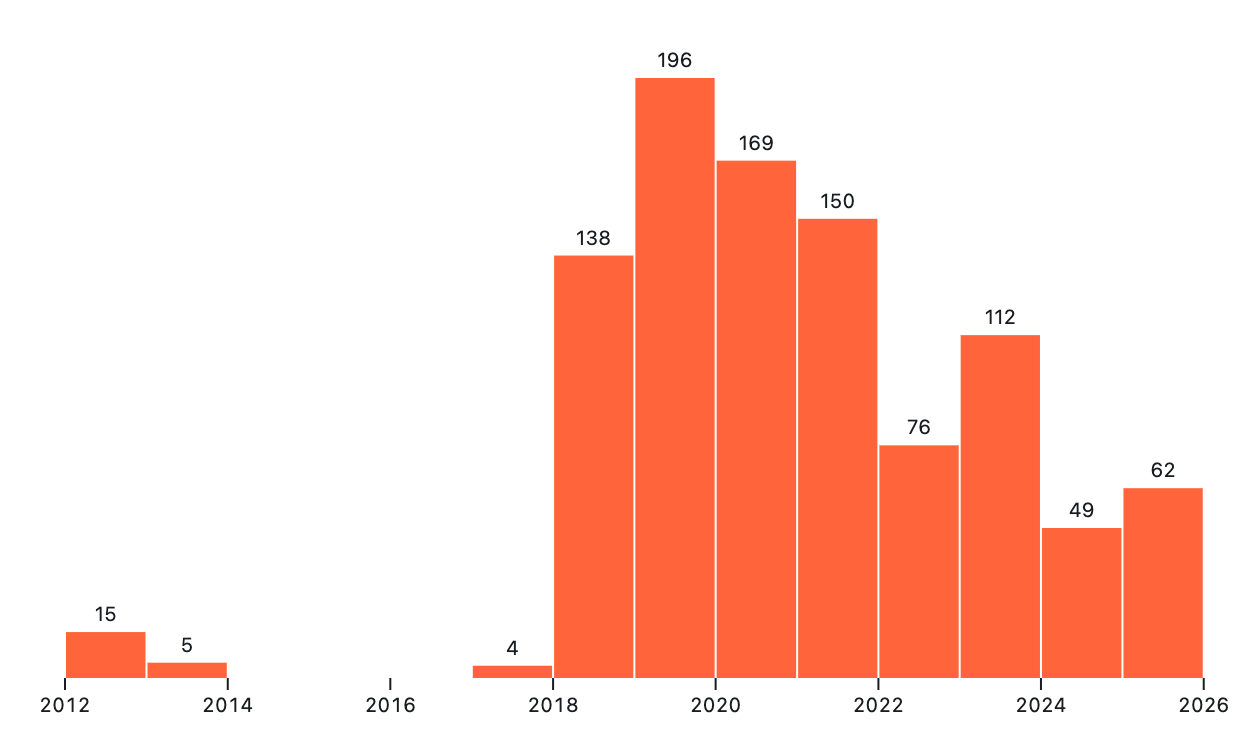
Number of new criminal prosecutions against Jehovah’s Witnesses in 2012–2025.
The gender composition of those prosecuted has remained stable, with 80% men and 20% women. A notable trend is the progressive “aging” of defendants: while in 2018 individuals over 50 years old accounted for around 30%, by 2025 this share had risen to 56%.
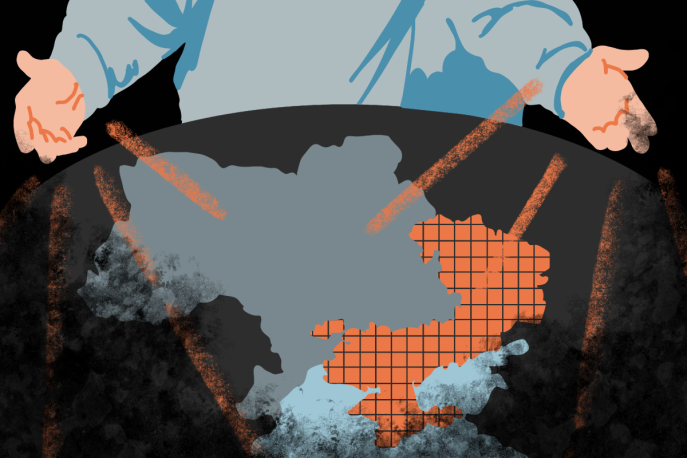
Illustration provided by an anonymous OVD-Info volunteer.
Regional patterns and arbitrariness of charges
Prosecutions have occurred nationwide, from Kaliningrad to Kamchatka. While Primorsky Krai has historically recorded the highest number of defendants (67), it cannot be seen as the sole or consistent leader, as the regions with the most initiated prosecutions have shifted from year to year. Overall, the pattern of prosecutions indicates that charges were not always based on concrete evidence of extremist activity. Rather, they were frequently applied in a formalized manner, seemingly in line with regional “targets” for combating extremism, without thorough case-by-case evaluation.
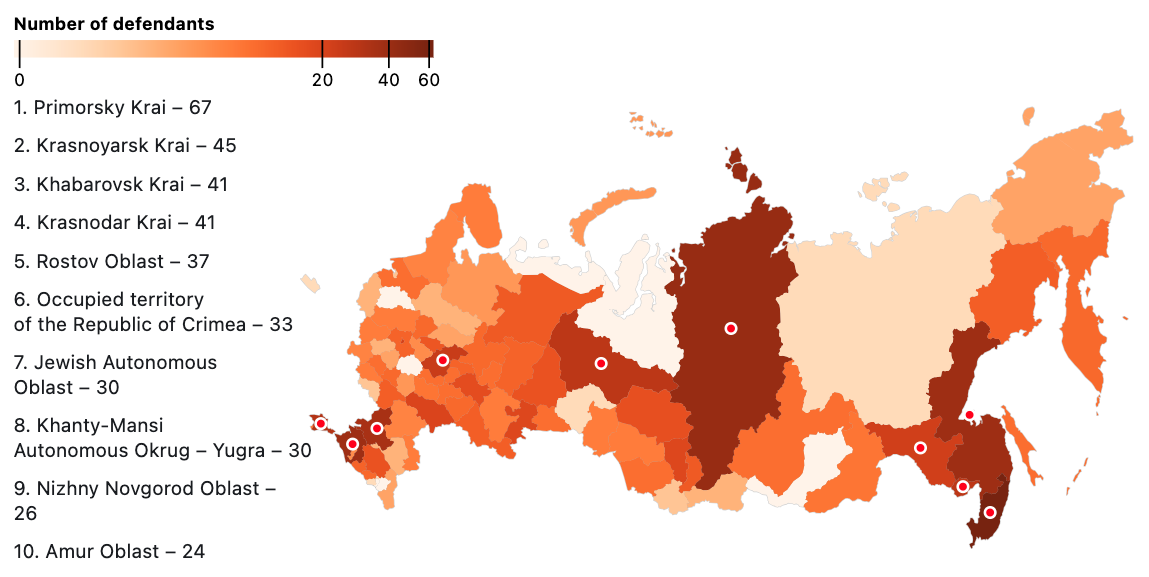
Geography of prosecutions of Jehovah’s Witnesses across the regions of Russia and the occupied territory of the Republic of Crimea. The list presents the 10 regions with the highest number of cases in 2012–2025.
The arbitrary division of defendants into “organizers” and “participants” highlights the repressive and artificial nature of law enforcement practices. In some regions—for example, Tatarstan or Voronezh Oblast—security services prosecute only “organizers” (Part 1 of Article 282.2 of the Criminal Code), while largely ignoring rank-and-file believers. In others, such as the Jewish Autonomous Oblast and Magadan Oblast, only “participants” (Part 2 of Article 282.2) are prosecuted, resulting in the paradoxical situation of an organization being treated as existing without identifiable leadership.
Charges related to “financing” extremism were most actively pursued in 2018–2020 and only in a limited number of regions (including Kirov Oblast, Omsk Oblast, and Stavropol Krai). Since 2019, the occupied territory of the Republic of Crimea has been distinctive in this regard: until 2023, defendants were frequently charged with both “organizing” and “financing” extremist activities, yet only two faced charges for participation alone.
When all three types of activity are pursued together, the corresponding charges are often brought years apart. In some instances, the number of “organizers” even exceeds that of “participants,” as seen in Krasnoyarsk Krai. Charges related to financing largely disappeared across most regions after 2020, remaining only in Crimea and Primorsky Krai. This selective and uneven application of charges indicates that investigators do not engage with the actual structure of the communities, but rather treat Criminal Code provisions as a formal tool of pressure within broader enforcement campaigns.
Judicial practice and the role of appeals
The most common sentence for “organizers” is actual imprisonment in a general-regime penal colony (43% of cases), whereas “participants” are more frequently given suspended sentences (61%).
The charge of “financing” (Article 282.3 of the Criminal Code) deserves particular attention. Although it is used less frequently, its inclusion in a case serves as a basis for harsher sentencing: when financing is added, prison terms increase by an average of two years. Likewise, combining “organization” with “participation” typically adds about one additional year of imprisonment.
An analysis of appeals shows that higher courts rarely mitigate sentences. Over a seven-year period, the vast majority of custodial sentences were upheld: 89% of convictions for organizing and 79% of convictions for participation were confirmed. When sentences are reduced, the average decrease is approximately eight months.
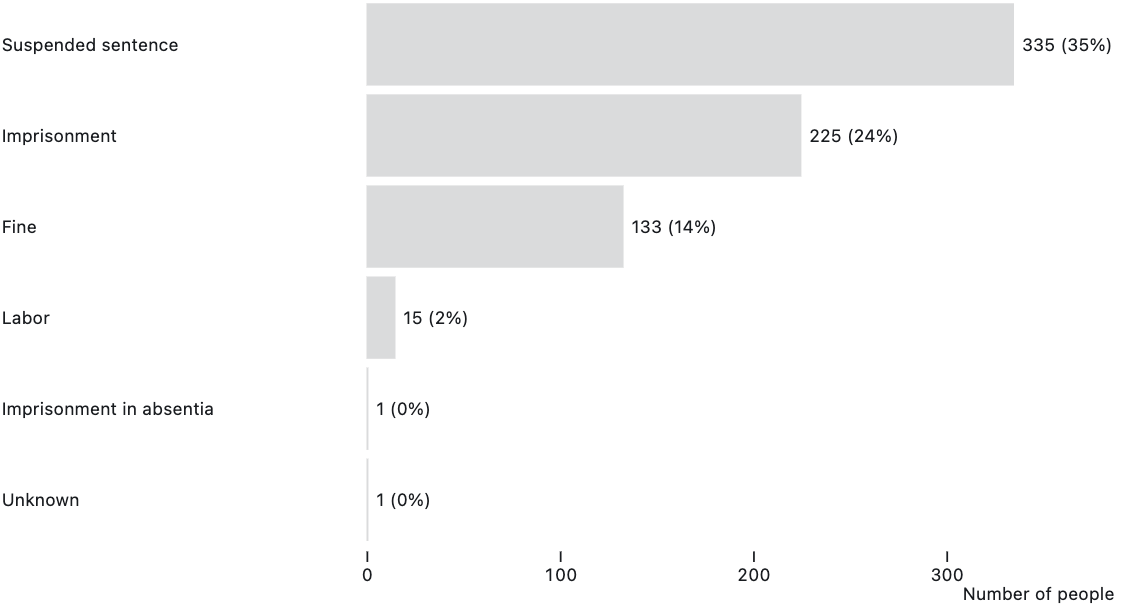
Results of 698 sentences against Jehovah’s Witnesses in 2012–2025 (note that one individual may be sentenced to multiple types of punishment).
Inclusion on the list of “undesirable organizations”
The pressure exerted on Jehovah’s Witnesses subsequently shifted from targeting their internal structures to isolating believers from the international community. While the 2017 ruling led to the liquidation of their legal entities in Russia, measures taken in 2023 were aimed at severing their cross-border connections.
On September 12, 2023, three key foreign organizations of Jehovah’s Witnesses were added by the Prosecutor General’s Office of the Russian Federation to the register of “undesirable” organizations:
- Wachtturm Bibel- und Traktat-Gesellschaft der Zeugen Jehovas (Germany);
- Religious Centre of Jehovah’s Witnesses in Ukraine;
- Watch Tower Bible and Tract Society of Pennsylvania (United States).
Texte
Corps
Since these foreign entities are responsible for publishing the organization’s main literature and maintaining its information resources, their designation effectively creates an information blockade and renders the reading and distribution of virtually all contemporary Jehovah’s Witnesses materials unlawful in Russia. The inclusion of the Ukrainian center in this list further reflects the authorities’ intention to restrict any contact between believers in the two countries, turning religious ties into grounds for politically framed accusations.
Since these foreign entities are responsible for publishing the organization’s main literature and maintaining its information resources, their designation effectively creates an information blockade and renders the reading and distribution of virtually all contemporary Jehovah’s Witnesses materials unlawful in Russia. The inclusion of the Ukrainian center in this list further reflects the authorities’ intention to restrict any contact between believers in the two countries, turning religious ties into grounds for politically framed accusations.
Illustration provided by an anonymous OVD-Info volunteer.
Conclusion
The history of Jehovah’s Witnesses in modern Russia originates from the period of unprecedented liberalization in the early 1990s. The 1990 law “On Freedom of Religion” and the adoption of the 1993 Constitution paved the way for religious pluralism, allowing the movement to officially register and emerge from the Soviet-era underground. However, this period of freedom proved short-lived. By the late 1990s, there developed an “anti-cult coalition” which included ROC hierarchs and state structures. The concept of “spiritual security” was introduced into the political lexicon. Jehovah’s Witnesses became the first major group to undergo a transformation from a legal religious association into a “social threat.”
The 2017 Supreme Court ruling banning the organization turned Jehovah’s Witnesses into a “testing ground” for a mechanism of mass and technologically “low-cost” repressions. The essence of this model lies in designating an organization as “extremist,” which allows for the criminalization of any basic activity of its supporters as “continuation of activities” (Article 282.2 of the Criminal Code). This repressive matrix was later successfully scaled to other civil society groups: from the political opposition (the Anti-Corruption Foundation and Alexei Navalny’s headquarters) to youth democratic movements (“Vesna”) and even undefined social groups (the designation of the “International LGBT Movement” as extremist) giving a carte blanche for the criminal prosecution of anyone who shares particular views or participates in peaceful antiwar gatherings.
The nature of the application of this legislation in the regions reveals deep formalism and an interest in imposing repressive political pressure. Analysis of criminal cases shows a lack of consistent logic: in some regions, only “organizers” are prosecuted, while in others, only rank-and-file “participants” are targeted. This indicates that law enforcement and judicial authorities were engaged in fulfilling regional quotas for “combating extremism” rather than trying to provide evidence of the danger posed by particular groups in a competitive legal process.
With the start of the full-scale invasion of Ukraine in 2022, the pace of new prosecutions against Jehovah’s Witnesses has slowed slightly, yet the overall scale of anti-extremist legislation usage in Russia continues to grow. This is confirmed by the data of the Federal Financial Monitoring Service (Rosfinmonitoring): their list of “terrorists and extremists” has been expanding at a record pace over the past three years, including ever-new categories of citizens.
28Repressions are supplemented by the law on “undesirable organizations,” which is used to sever trans-border connections. The designation of foreign Jehovah’s Witnesses centers as “undesirable” in 2023 effectively isolates Russian believers from the international community, turning their religious identity into grounds for accusations of working for external hostile forces.
Notes
1
Étienne Ollion, Raison d’État. Histoire de la lutte contre les sectes en France, Paris, La Découverte, 2017.
2
For a history of Jehovah’s Witnesses, see Emily Baran, Dissent on the Margins. How Soviet Jehovah’s Witnesses Defied Communism and Lived to Preach About It, Oxford, Oxford University Press, 2014.
3
The Soviet Encyclopedic Dictionary (1979) defines sects (sektantstvo) as “religious groups that adopt an attitude of opposition or hostility toward dominant churches. The phenomenon emerged as a form of social and anticlerical protest by oppressed masses. It is characterized by fanaticism, dogmatism, and hostility toward dissenters. Some sects practice cruel rites.”
4
Between 1955 and 1967, studies on Jehovah’s Witnesses accounted for 17% of the literature on so-called sectarian religious groups. See Aleksandr Klibanov, “Piat’desiat let nauchnogo issledovania religioznogo sektantstva,” Voprosy naucnnogo ateizma, 1967, n°4, p. 378. Several Soviet researchers focused specifically on the movement: Aleksei T. Moskalenko, Eduard G. Filimonov or Petr L. Iarotskii.
5
Soviet Youth organizations.
6
In 1991, there were 45,000 of them in the Soviet Union.
7
Opredelenie “O psevdokhristianskikh sektakh, neoiazychestve i okkul’tizme,” https://old.mospat.ru/archive/page/sobors/1994-2/517.html
8
Lawrence Uzzell, “Les restrictions aux droits des minorités religieuses au sein de la Fédération de Russie ”. Istina, 42(4), 1997, p. 350 [note 1].
9
Marat Shterin and James Richardson, “ Effects of the Western Anti-Cult Movement on Development of Laws Concerning Religion in Post-Communist Russia”, Journal of Church and State, 42(2), 2000, p. 248 (note 2). Available on line: https://www.jstor.org/stable/pdf/23921284.pdf
10
Marat Shterin and James Richardson, “Effects of the Western Anti-Cult Movement on Development of Laws Concerning Religion in Post-Communist Russia”, Journal of Church and State, 2000, 42(2), Marat Shterin and James Richardson, art.cit., pp. 247-271. Available on line: https://www.jstor.org/stable/pdf/23921284.pdf
12
Ukaz Prezidenta ot 17 dekabria 1997 goda N°1300 “ Ob utverzhdenii Kontseptsii natsional’noi bezopasnosti Rossiiskoi Federatsii, https://yeltsin.ru/archive/act/39691/ (p.25).
13
Kontseptsia natsional’noi bezopasnosti Rossiiskoi Federatsii, http://www.kremlin.ru/acts/bank/14927/page/3
14
Strategia national’noi bezopasnosti Rossiiskoi Federatsii ot 02 iulia 2021 g., https://www.mid.ru/ru/foreign_policy/official_documents/1784948/
15
From June 1, 1998, to 2009, he worked in the Department for External Church Relations of the Moscow Patriarchate. In 2005, he participated in the synodal working group tasked with drafting a document on the position of the Russian Orthodox Church in the field of interreligious relations. Since 2006, he has been an active member of the World Russian People’s Council.
16
Igor Shatrov, “Sekty-effektivnyi sposob vliania na politicheskie protsessy”, October 06th .10.2020, https://www.pravda.ru/society/1534756-religioznye_sekty/
17
FIDH, Mediazona, Russian Federation: repressive laws since 2028, April 2023.
18
Source: Ministry of Justice of the Russian Federation. List of extremist organizations: https://minjust.gov.ru/ru/documents/7822/
(access to this webpage was restricted at the time when this article was written and typically available only from within Russia).
19
Stenogramma 396 zasedania Soveta Federatsii, cited by Anastasia Isaeva, “Pravovoe regulirovanie missionerskoi deiatel’nosti: rossiiskie realii i opyt stran Sodruzhestva Nezavisimykh Gosudarstv”, Sravnitel’noe konstitutsionnoe obozrenie, №3 (118), 2017, p.29.
20
“Osuzhdennym iegovistam sozdaiut oreol muchenikov, chtoby davit’ na Rossiiu - religioved”, Akhilla, 8 February, 2019, https://ahilla.ru/osuzhdennym-iegovistam-sozdayut-oreol-muchenikov-chtoby-davit-na-rossiyu-religioved/
21
Sova, “Presledovania Svidetelei Iegovy v Taganroge”, September 14, 2009, https://www.sova-center.ru/misuse/news/persecution/2009/09/d16846/
22
Sova, “V Taganroge vnov’ vynesen obvinitel’nyi prigovor po “delu 16-ti”, November 30, 2015, https://www.sova-center.ru/misuse/news/persecution/2015/11/d33339/
23
“Svideteli Iegovy v Rossii. Voprosy svobody religii. Otchet Upravlencheskogo tsentra Svidetelei Iegovy v Rossii. Zasedanie OBSE po realizatsii mer po voprosam chelovecheskogo izmerenia, Varshava”, September 19-30, 2016, https://odihr.osce.org/sites/default/files/f/documents/3/6/268406.PDF
24
According to an association supporting victims of cults, “in addition to the state, one of the architects of this ban is an organization called ‘Youth Emergency.’ Its founder created a specific branch dedicated to combating sects after being approached at his home by Jehovah’s Witnesses. In his view, the teachings of the Watch Tower are dangerous for both citizens and the Russian state.” See “Les Témoins de Jéhovah interdits”, Union nationale des Associations de Défense des Familles et de l’Individu victimes de sectes, May 22, 2017, https://www.unadfi.org/actualites/groupes-et-mouvances/les-temoins-de-jehovah-interdits/
25
Glava VS: “Svideteliei Iegovy” presleduiut ne za veru, a za narushenie zakona, https://ria.ru/20190212/1550736784.html
26
OVD-Info: It’s always the same story. What are the cases against Jehovah’s Witnesses based on? (In Russian) July 7, 2020, https://ovd.info/articles/2020/07/07/odna-i-ta-zhe-istoriya-na-chem-stroyatsya-dela-protiv-svideteley-iegovy
27
See the Live Data gathered by OVD-Info : https://ovd.info/en/pulse/jehovah-witnesses
28
Dynamics of expansion of Rosfinmonitoring’s list of terrorists and extremists is tracked by OVD-Info: https://ovd.info/pulse/rosfinmonitoring


