

(OVD-Info)
Political repression in Russia affects not only political activists and independent journalists, but also critical human rights organizations. Since the era of perestroika, civil society associations have played a crucial role in Russian political life, particularly in a context where opposition parties and trade unions have struggled to develop. From the mid-1990s onward, NGOs such as Memorial increasingly engaged in the defense of human rights. NGOs specializing in the fight against police brutality or abuses committed in detention centers have also emerged.
While pressures on the non-governmental sector were already noticeable, they intensified significantly during the 2010s with the emergence of legislation targeting so-called “foreign agents.”
1Activists have been persecuted, and NGOs deemed “non-constructive” or suspected of ties with the West have been subjected to sustained administrative and legal harassment. The full-scale invasion of Ukraine in 2022 forced a significant portion of Russia’s civil society sector into exile, particularly its most prominent figures.
The 2022 offensive also brought about a profound transformation in the conduct of academic research across the post-Soviet space, including within Russia itself. Immediately following the invasion, academic partnerships between European and North American universities and their Russian counterparts were suspended, after the publication, on March 4, 2022, of an address signed by more than 300 senior higher education officials expressing their support for the Russian government’s so-called “demilitarization” and “denazification” operation in Ukraine
2. Ongoing research programs had to be abandoned due to the increasing risks. Not only did Russia become inaccessible to foreign scholars, but local researchers were also at risk of being accused of collusion with “undesirable organizations” or even of espionage and high treason on behalf of Western powers. In such a context, how can research activity meaningfully continue? How can we continue to study the inner workings of a country accelerating into authoritarianism, especially with access increasingly restricted?
The need for new partnerships
For researchers in sociology, political science, history and anthropology, the choice is relatively straightforward: either they change their research topic or their fieldwork location, or they adapt their methodologies. Some have turned their attention to Russian populations in exile. Others have opted for remote analysis of Internet data using digital tools. In our case, we chose to engage with non-academic producers of independent sources on Russian society—particularly within the associative sector, where organizations such as OVD-Info are active.
Despite being designated a “foreign agent” in 2021, the forced departure of part of its team from Russia, and its placement on the list of “extremist organisations” in 2026, this NGO—founded in 2011 and reputed for its methodological rigor—continues to produce data on ongoing repression. Collaborating with OVD-Info not only expresses solidarity with one of Russia’s leading human rights organisations. The NGO played a well-known key-role in documenting arrests and political trials linked to the “Bolotnaya” protests in 2012
3and has since expanded its activities to include legal assistance to detainees, public awareness campaigns, and statistical analysis. Furthermore, this collaboration fosters dialogue around judicial sources and the data produced by the organization itself. OVD-Info distinguishes itself from other NGOs working in this field through the diversity of raw data it collects on repression and the expertise it has developed in gaining access to such sources.
The political situation in Russia presents a serious challenge for researchers: traditional academic timelines struggle to keep pace with real-time repression. This is especially true in areas such as evidence-gathering around mass human rights violations. For researchers, such data is increasingly vital to understanding law enforcement in a war context. For activists, it is important to adjust the tactics. For policymakers, it supports more informed and accountable decision-making. OVD-Info exemplifies the evolving role of civil society. It is not merely a team of experts—it is a dynamic network comprising hundreds of lawyers and thousands of volunteers, trusted by dozens of thousands of citizens.
Building a symbiotic relationship
This dialogue between the academic and associative worlds does not blur their respective roles. Each remains within its domain: the NGO provides access to its data, rigorously collected and analyzed as part of a civil initiative aimed at affirming society’s right to hold the state accountable; on the other side, academics interrogate this data, propose new lines of inquiry, and anchor the reflection within historical or comparative frameworks.
Such an exchange can only be fruitful if there is clear awareness of the risks inherent to this type of collaboration. The existing literature—particularly within development studies—on the “co-production” of research between academics and NGOs highlights well-known risks, including asymmetrical forms of cooperation or diverging objectives between the two parties, especially in North-South contexts.
4The primary pitfall to avoid lies in familiar forms of academic extractivism, whereby data produced by NGOs is exploited in ways that primarily benefit researchers, to the detriment of the organizations themselves. Yet one crucial fact must be acknowledged: it is these NGOs that assume the risks inherent in collecting sensitive sources on the ground, maintaining communication with political prisoners, and publishing analyses documenting the ongoing political repression under Putin’s regime.
Hence the need to develop symmetrical and mutually beneficial forms of cooperation. In this case, the main initiative has been the creation of an English-language seminar designed to promote and disseminate the often-unpublished sources produced by OVD-Info. These sources offer valuable insights into whether and how the full-scale invasion of Ukraine in February 2022 has transformed the “legislative arsenal, surveillance systems, police and judicial activity, as well as the extralegal violence committed against dissidents and journalists”
5. This joint seminar, titled “Political Repression in Russia, 2012–2023: Data, Actors and Practices”, was organised by OVD-Info and a group of French researchers—Françoise Daucé (CERCEC), Gilles Favarel-Garrigues (CERI), and Anne Le Huérou (ISP) —with support from Labex Tepsis, CERCEC, and the association L’Archipel.
Illustration provided by an anonymous OVD-Info volunteer.
This seminar proved remarkably successful, attracting over 250 participants, including 130 researchers from 60 institutions across 19 countries (Europe, Canada, USA and Russia). Its success was likely due to a combination of the topic’s urgency, the strength of the hosting organizations, and the reputation of the NGO activists and researchers involved. The seminar served as a regular virtual meeting space for a dispersed community. Seven sessions were held between October 2023 and May 2024, including two focused on sources documenting the process between arrest and trial, one on judicial acts published, one on judicial statistics, and one on implementation of the “foreign agents” legislation.
The seminar provided an opportunity to examine both the conditions of data production and the limitations of data collection. Publicly accessible government sources have been steadily shrinking since the late 2000s. Under the presidency of Dmitry Medvedev, then regarded as “liberal,”
6a push for transparency extended even to law enforcement institutions. Courts, for instance, were required to publish detailed reports of their activities. Today, the available picture is considerably more restricted, with significant regional disparities. Despite these obstacles, OVD-Info continues to document current forms of repression—including administrative and criminal justice—, the legal charges invoked, the sentences imposed, and the individuals targeted.
Expansion of repression
The full-scale war triggered numerous changes in the Criminal Code. Thus, the volume of amendments and additions for 2022 amounted to 7.2% of the size of the whole text. Most of these changes are in one way or another related to the outbreak of the full-scale war, and some of the novelties are used to suppress dissent in Russia, not necessarily anti-war dissent. One notable development since 2022 is the targeting of lawyers, alongside journalists and political activists. In general, those being prosecuted are no longer necessarily opposition figures or activists, but potentially anyone. This generalized repression is accompanied by public denunciations and extralegal violence, often carried out by groups or individuals presenting themselves as concerned citizens—actors who are either tolerated or actively encouraged by the regime. As numerous instances of collusion over the past two decades have demonstrated, the repressive apparatus operates on two fronts—judicial and extrajudicial—and increasingly unfolds within society itself.
7For OVD-Info, the rapidly unfolding changes—combined with the introduction of military censorship—raised complex and pressing questions. With the beginning of the full-scale invasion, OVD-Info started publishing monthly bulletins on how repression and censorship in Russia and in temporarily occupied territories of Ukraine were intensifying. By doing this work regularly, in a constantly changing and evolving context, the OVD team started to question themselves: how to provide this information in a regular way, more accessible for analysis of the changes and without spending so much resources? In response, the project began to experiment with new formats featuring regularly updated data. The seminar offered OVD-Info another opportunity for reflection and became a space for experimentation, ultimately helping the team discover a new approach to presenting their data.
Illustration provided by an anonymous OVD-Info volunteer.
As such, OVD-Info prepared a number of computational notebooks designed to explore the latest available data. Some of the materials developed during the initial seminar eventually evolved into a more comprehensive platform: the Russian Repression Dashboard—a digital tool created to track and visualize data on politically motivated criminal prosecutions in Russia.
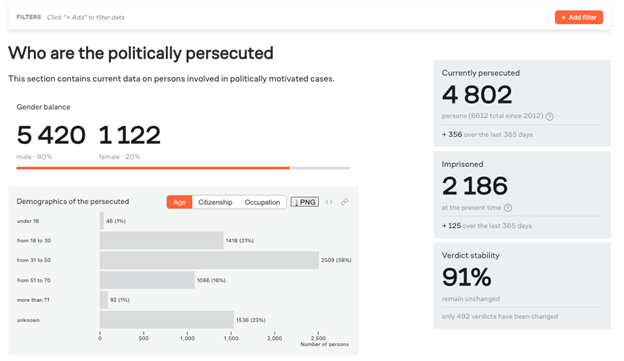
Data on politically motivated criminal persecutions in Russia.
The Dashboard brings together data on new arrests, charges, verdicts, and imprisonments, allowing users to identify broad trends and to examine individual case studies. It was accompanied by a detailed report offering an in-depth analysis of those currently held in detention. Importantly, the project keeps the human stories visible behind the numbers: almost every chart and figure can be used to generate a specific sample of persecuted individuals and to read their stories. This was, and remains, a central goal for OVD-Info—to ensure that data never loses its connection to the people affected.
What began as a single dashboard has since become the foundation for a broader approach. The technology first developed for the Russian Repression Dashboard was subsequently refined and extended into a family of more specialized, automatically updated dashboards, each opening up a distinct dimension of repression in Russia. One continues to track politically motivated criminal prosecutions as a direct successor to the original tool, recording the number of people currently persecuted or imprisoned, the stability of verdicts over time, and the cases behind each figure. Another focuses on the persecution of Jehovah's Witnesses—the single most widely prosecuted community in present-day Russia, whose unusually well-documented cases offer a revealing lens onto how "extremism" legislation is applied in practice. A third examines the Rosfinmonitoring "Watchlist of Terrorists and Extremists", a registry originally conceived as an instrument against the financing of terrorism that has become an important, if indirect, indicator of the scale of repression, as a growing share of entries is added on political grounds. Updated daily, these dashboards turn what was once a periodic snapshot into a continuously refreshed picture of repression as it unfolds. Conceived for journalists, legal professionals, policymakers, and researchers seeking to understand the current state of repression in Russia, their further development will continue to depend on sustained engagement and feedback from these communities.
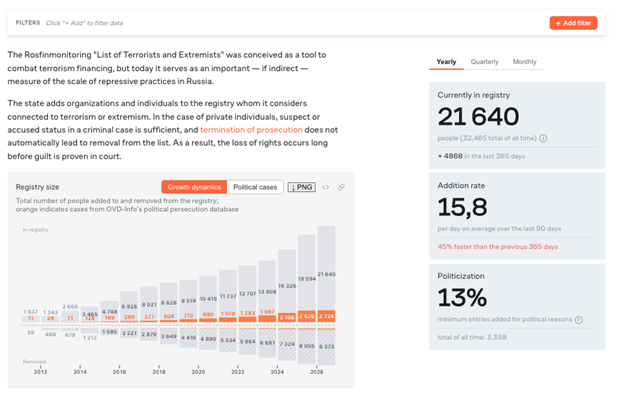
Figure 2: How Russia’s Rosfinmonitoring Terrorism and Extremism Watchlist Works. Live Data by OVD-Info
The seminar not only provided OVD-Info with an opportunity to experiment with new formats, but also became an important moment of self-reflection for the team. Different parts of the organization were actively involved in the preparations. This collaborative process encouraged internal dialogue and self-reflection on how best to communicate complex information under conditions of censorship and rapid political change.
The seminar also served as a meeting point for some data journalists (Mediazona, Novaia Gazeta), and academic researchers. It provided a platform for the development of further projects, grounded in the same spirit of symmetrical collaboration: joint participation in conferences and academic events (EHESS, University of Paris-Nanterre, Sciences Po, the Aleksanteri Conference in Helsinki, the Allez Savoir Social Sciences festival in Marseille), co-authored publications, and collaborative research initiatives.
Some reflections and the outcomes of preparatory work for the seminar will be featured in the book The Evolution of Repressive Law in Putin’s Russia, authored by Professor Lauren A. McCarthy of the University of Massachusetts Amherst and independent researcher Olga Schwartz. The book examines the development of a repressive legal framework in Russia under Vladimir Putin, tracing its trajectory from the early 2010s to the present day. Each chapter of the book explores a specific area of law that has been instrumental in suppressing political opposition and other targeted groups. OVD-Info played an active role in this project.
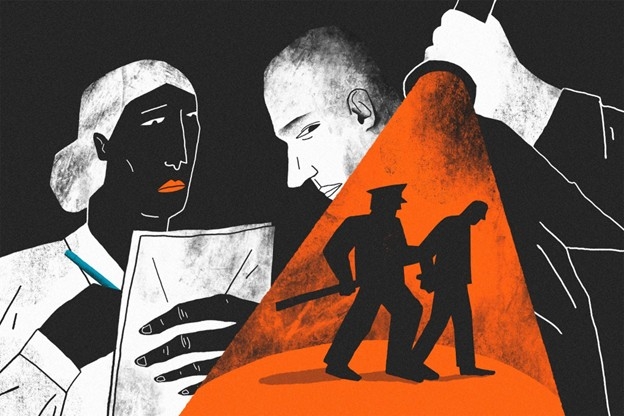
Illustration provided by an anonymous OVD-Info volunteer.
Another particularly original initiative was the creation in 2024 of an international prize for early-career researchers. This award is designed to respond to the knowledge gaps caused by Russia’s increasing isolation, by encouraging master’s and doctoral students from around the world to develop research based on available sources relating to repression, surveillance, and censorship in contemporary Russia. Regardless of their disciplinary background, candidates are welcome to consult with OVD-Info to increase their chances of accessing relevant data for their projects. In doing so, we aim to foster the development of new lines of academic inquiry and to support the emergence of a new generation of specialists in the field.
Looking ahead
Understanding ongoing political repression in Russia is a shared responsibility. Civil society plays an indispensable role in this process, shedding light on repression, legislative developments, and civic resistance. However, human rights defenders operate under significant pressure: within Russia, they are under direct attack, and in exile, they face a lack of institutional support. The academic community in Western countries bears a particular responsibility to support Russian civil society organizations (CSOs). This support should go beyond occasional assistance and aim to build a strong, long-term partnership that is mutually beneficial and inclusive of diverse organizations. Collaboration between academia and civil society provides a powerful foundation for generating knowledge, defending fundamental rights, and ultimately shaping a more just and democratic future. One promising approach would be to institutionalize these relationships through the creation of a human rights observatory focused on Russia. Such an observatory could bring together Western universities and human rights organizations to develop joint projects and initiatives.
This series of articles builds on discussions from the seminar "Political Repression in Russia, 2012–2023: Data, Actors, and Practices," and examines how the full-scale invasion of Ukraine in February 2022 has deepened and diversified the tools of repression in Russia. The contributions explore the mutual benefits of collaboration between academia and civil society organizations (CSOs), analyze key trends such as the application of the "foreign agents" law after February 2022, and investigate the forms of judicial censorship and the phenomenon of religious persecution. Together, these texts provide a comprehensive overview of how state repression has evolved in recent years and the importance of collective efforts to document, understand, and resist it.
Notes
1
Françoise Dauce (2023). “Les ‘agents de l’étranger’ dans la Russie en guerre. Genèse, expérience et recomposition d’un dispositif oppressif”, Revue française de science politique, 73(6), pp. 861-881; Maxim Krupskiy, , “Discrimination à l'encontre des ‘agents étrangers’ en Russie : dynamique d'une législation répressive”, La Revue des droits de l’homme [On line], April 29th 2025. DOI: https://doi.org/10.4000/13u2j
2
See the text of the Address of the Russian Union of Rectors in: https://rsr-online.ru/news/2022/3/4/obrashenie-rossijskogo-soyuza-rektorov/
3
On May 6, 2012, a protest march was organized at the Bolotnaya square in Moscow. It was one of the biggest demonstrations organized against the government under Putin. Around 450 persons were arrested, and 37 persons were accused of alleged mass riots and alleged violence against the police.
4
Chika Charles Aniekwe, Rachel Hayman, and Anna Toner, Academic-Ngo Collaboration in International Development Research: A Reflection on the Issues (September 1, 2012). Available at SSRN: http://dx.doi.org/10.2139/ssrn.2995689
6
Since Russia’s invasion of Ukraine in 2022, Dmitry Medvedev has instead become known for his hardline rhetoric, invoking the threat of a third world war and mocking Western powers.
7
Gilles Favarel-Garrigues, “Vigilante Shows” and Law Enforcement in Russia, Europe-Asia Studies, 73(1), 2021, pp.221-242.


